Nursing students need structured guidance to develop clinical reasoning skills beyond rote memorization, emphasizing active engagement over exams.
One underlying challenge I've observed among nursing students is their consistent request for more detailed study guides. While it might seem that they're primarily focused on what will appear on exams, many are actually expressing a deeper need for clarity and guidance amidst the vast and complex information presented during their courses.
Many students enter nursing programs with an ingrained habit of rote memorization, but succeeding in nursing entails mastering the art of clinical reasoning—recognizing significant clinical cues, prioritizing patient needs, and applying knowledge to novel situations. The shift towards fostering clinical reasoning and judgment has become increasingly pertinent in nursing education, as highlighted in recent studies (Gonzalez et al., 2021; Camp-Spivey et al., 2024).
What often struck me was that when students sought more detailed guidance, they grappled with discerning what truly mattered in their studies and how to effectively structure their learning. A number of students candidly posed the question, “Can you just tell us exactly what to study?” This query, though it might hint at a desire for shortcuts, often reflects a genuine need for direction and affirmation. While crafting elaborate study guides might initially seem like a solution, I pivoted toward creating interactive learning activities aimed at practicing the thought processes crucial for nursing.
The Strategy
To transition students from mere memorization to actual clinical reasoning, I integrated recognition-based clinical judgment worksheets into the curriculum. These worksheets, designed by faculty, present succinct patient scenarios coupled with open-ended questions that challenge students to apply their knowledge actively. Through prioritization exercises and application-based inquiries, the worksheets invite students to discern meaningful cues, articulate their reasoning, prioritize issues, and validate their nursing decisions. Evidence suggests that methods emphasizing practical application significantly enhance clinical judgment capabilities in nursing students (Watkins et al., 2025).
Importantly, these worksheets are not intended to replace traditional reading materials or class lectures. They serve as a structured mechanism for students to engage meaningfully with course content while practicing essential clinical reasoning skills.
For example, Figure 1 demonstrates a sample recognition-based clinical judgment worksheet. This resource can easily adapt to align with specific course content and objectives, fostering cue recognition, prioritization skills, rationale articulation, and constructive group discussions.
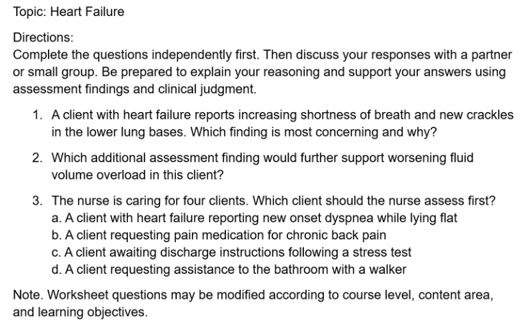
Figure 1. Sample Recognition-Based Clinical Judgment Worksheet
Implementation of Worksheets
The process begins with students completing the worksheets independently, followed by a think-pair-share format that promotes collaborative problem-solving. This format allows students to compare their answers, deliberate on their reasoning, and explore various perspectives before opening the floor to a larger class discussion.
Through these collaborative dialogues, students often realize that their classmates interpret the same scenario differently, creating rich opportunities to discuss clinical reasoning and challenge preconceived notions. Faculty-guided discussions emphasize the reasoning process rather than merely identifying correct answers, further encouraging students to articulate their thought processes.
This strategy has proven to enrich classroom discourse significantly. The varying conclusions drawn from identical scenarios spark discussions that reveal the complexity of clinical judgment, enabling students to learn not just from instructor feedback but also from peer insights.
Effectiveness of the Approach
By shifting focus from content memorization to knowledge application, students begin to ask more relevant questions, moving from “What’s on the test?” to “What’s the patient’s situation?” and “What evidence supports my reasoning?”
This method also nurtures student confidence. I've witnessed instances where students arrive at the correct conclusion but struggle to explain their reasoning. Others hesitate to contribute due to uncertainty in their thought processes. Engaging in structured reasoning activities enhances students’ abilities to articulate their clinical reasoning, justify their decisions, and draw connections between assessments and nursing interventions.
Crucially, confidence should not be conflated with overconfidence; rather, it represents a student’s readiness to participate, pose questions, and share insights regarding their clinical reasoning. Growth in both knowledge and judgment is evident when students can articulate their rationales for interventions or recognize potential complications.
Adapting the Approach for Faculty
Faculty looking to adopt this strategy can begin with small steps. Selecting a patient scenario that aligns with course objectives and crafting questions that prompt students to:
- Identify key assessment findings or patient cues
- Prioritize patient concerns
- Explain their decision-making rationales
- Anticipate potential complications
- Suggest appropriate nursing interventions
Worksheets don't have to be complex; often, the most engaging discussions stem from straightforward scenarios that prompt students to demonstrate their reasoning. After completing the worksheets, employing a think-pair-share strategy encourages productive interaction where students can challenge and refine each other's thought processes.
This format can be tailored for various nursing courses and learner levels, aiming not to narrow the focus to test content but to create an environment that fosters critical thinking through realistic scenarios.
Concluding Insights
The key takeaway from my experience is the distinction between what students ask for and what they genuinely need.
When students plead for increasingly elaborate study guides, they often seek assistance in how to organize their learning and approach complex clinical situations, rather than simply wanting answers. As educators, our role transcends exam preparation; we must cultivate the analytical habits necessary for real-world patient care. Active learning strategies that encourage analysis, rationale articulation, and meaningful discussions are vital for transitioning students towards effective clinical practice (Watkins, Fruin, and Brett, 2025).
Ultimately, the goal isn't to furnish students with a list of possible exam questions but to equip them with the cognitive tools necessary for caring for patients competently.
Dr. Rosa Diaz-Herring, DNP, RN, CNE, serves as an Assistant Professor of Nursing at Southern Connecticut State University. Her teaching focuses on developing clinical judgment, fostering confidence, and employing active learning strategies essential for effective nursing practice.
References
Camp-Spivey, L. J., Crawford, R. P., and V. Bratnichenko. 2024. “Bringing Next Generation NCLEX-RN Case Studies to Life Through Simulation: Enhancing Prelicensure Nursing Students’ Clinical Judgment.” Clinical Simulation in Nursing 91: Article 101535.
Gonzalez, L., A. Nielsen, and K. Lasater. 2021. “Developing Students’ Clinical Reasoning Skills: A Faculty Guide.” Journal of Nursing Education 60 (9): 485–493.
Wankier, J., and C. Beynon. 2025. “Enhancing Clinical Judgment in Undergraduate Clinical Education.” Teaching and Learning in Nursing 20 (1): 32–36.
Watkins, M., B. W. Fruin, and A. Brett. 2025. “Using Active Learning to Develop Clinical Judgment in Nursing Students.” Teaching and Learning in Nursing 20 (4): e1170–e1175.

Discussion
Sign in to join the discussion.