Valuing collaborative intelligence in education can transform assessment methods, recognizing the impact of peer interactions on learning outcomes.
**Redefining Intelligence in Education**
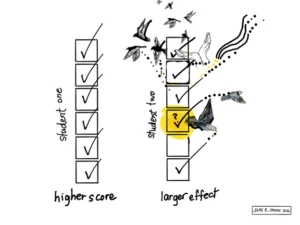
Consider the scenario of two students tackling a group project. One excels with a wealth of knowledge—she recalls every detail, grasps all theories, and completes her section ahead of schedule, eventually scoring a stellar 96% on the test. The second student, while less knowledgeable, plays a pivotal role in transforming his classmates’ understanding. He asks insightful questions, encourages quiet peers to participate, and translates complex ideas into accessible language.
At first glance, it seems natural that the first student would come out on top. But does this accurately reflect what we value in education? The first student’s proficiency demonstrates her intelligence, but the second student’s impact on the group showcases an equally important form of intelligence—one that cultivates collective understanding and enhances group performance.
**A Flawed Assessment Framework**
This raises significant questions about how we assess intelligence within educational settings. Traditional assessment models operate on the assumption that knowledge and skills reside solely within individuals. Assessing students, therefore, often involves isolating them away from one another to evaluate their personal knowledge. While we label this as an authentic learning demonstration, it’s worth pondering whether this approach genuinely reflects the complexities of cognitive processes.
Research by scholars such as [Anita Woolley](https://scholars.cmu.edu/418-anita-woolley) and [Thomas Malone](https://mitsloan.mit.edu/faculty/directory/thomas-w-malone) at Carnegie Mellon highlights the concept of **collective intelligence**. Their studies reveal that effective group performance is not merely a summation of individual intellect but arises from interactions and exchanges within the group. Simply put, intelligence, especially in collaborative environments, is co-created.
**The Paradox of Collaboration in Schools**
Schools profess to value traits like teamwork and communication, yet the reality often contradicts this ethos. During high-stakes evaluations, desks get separated, and students are instructed to focus solely on their own work. We say we endorse collaboration but, in practice, we undermine it by making it difficult for students to share ideas or seek help.
This contradiction stems from an assessment paradigm that privileges quantifiable knowledge over interpersonal skills. Individual capability is easier to measure—we can rank scores and feed numbers into spreadsheets. However, the impact one student has on their peers is much harder to document.
We need to look beyond rote recall to recognize important collaborative behaviors, such as a student’s ability to elevate a group’s critical thinking or their role in fostering resilience among peers. These contributions may not be quantifiable in traditional grades, but they should be recognized as critical dimensions of learning.
**Shifting Perspectives on Assessment**
The challenge necessitates a shift in how we think about assessments. Rather than focusing solely on individual knowledge, what if we also highlighted the contributions students make to their learning communities? An evolved assessment system would incorporate how students influence and enhance each other’s learning experiences.
Educational environments are already aware of this principle. A successful string quartet isn't evaluated by each musician's ability to play alone, nor is a basketball team merely ranked by points scored. Performance in these domains depends heavily on collaboration, cohesion, and other collaborative competencies.
In contrast, many academic settings still cling to outdated metrics that isolate student performance, ignoring the symbiotic nature of real learning.
**A Need for Dynamic Measurement**
The intricacies of learning extend beyond single days or specific instances; they encompass progressive journeys. Most current assessments capture only a snapshot at one moment in time. Yet, learning is inherently fluid—it involves obstacles, collaborations, and revisions. We should be tracking the evolution of a student's thought processes as much as we note the end result.
Consider the process: a student wrestles with a concept, seeks and receives feedback, tests an idea, and refines it through peer interaction. If measurement only focuses on final outputs, we overlook much of this rich learning narrative.
To cultivate understanding, educators must collect data continuously—small, frequent assessments that gauge students’ movements along their learning trajectories.
**Reimagining Educational Outcomes**
Places like the [Workshop School in Philadelphia](https://www.workshopschool.org/) exemplify a more holistic assessment model where student participation in public exhibitions allows for reflection on both individual growth and collective impact. Reflective practice becomes integral to demonstrating learning. Asking deeper questions about how a student contributed to their peers’ development introduces a paradigm shift in educational evaluation.
Such innovative approaches challenge the traditional notion of assessment: rather than solely identifying what a student knows, a more comprehensive evaluation would consider how that learner amplifies the capabilities of their community.
Ultimately, what if we could measure contribution as a valid form of learning? By tracking the ripples of a student's influence on their environment, we won't just capture knowledge but also illuminate the communal fabric of education itself.
This evolution in thinking about intelligence and assessment is not merely beneficial; it's essential for creating environments that truly support learning—both for individuals and their communities. Is this a transformative shift we can embrace in our classrooms? Absolutely. The question is, how soon will we implement it?
The Notion of Ripples: Rethinking Educational Outcomes
As we wrap up, it's essential to reconsider how we measure success in education. The traditional view, fixated on direct correlations between efforts and outcomes, falls short of capturing the true dynamics of human learning. Unlike mechanical processes, learning is messy and unpredictable, often making connections and producing effects in ways that defy linear evaluation. This shift in mindset is not just a subtle nuance; it has significant implications for how we understand and validate what takes place within classrooms.
By redefining ROI as "Ripples of Impact," we enter a world rich with possibilities. This approach prompts us to look beyond simple metrics—like test scores or task completion—and instead encourages an exploration of how learning influences not just the individual, but also others in their environment. Questions like "Who benefited from this student's insights?" or "What new perspectives were introduced?" reveal layers of impact that traditional assessments overlook. This perspective emphasizes the interconnectedness inherent in learning communities.
Reforming Assessment: A Dual Question Framework
Implementing this revised framework doesn’t necessitate overhauling existing accountability systems overnight. Instead, educators can begin by augmenting standard inquiries with a secondary question—one that probes deeper into the shared experiences of learning. For example, alongside asking what a student knows, they could explore whom that knowledge has empowered. Placing these questions side by side creates a richer dialogue around the learning process itself.
The potential for innovation in assessment practices is vast. Imagine exhibition rubrics or peer feedback mechanisms that not only document individual achievements but also highlight collaborative learning moments. Teachers can look for instances where students clarified misunderstandings or spurred group discussions, emphasizing the importance of individual contributions to collective understanding.
Such insights not only inform educators about where students stand in their learning journeys but also guide future instructional strategies. Are students fully engaged with diverse perspectives? Are they leading discussions rather than just participating? These reflections, prompted by the dual-question strategy, can reshape classroom dynamics and cultivate deeper connections.
At its core, assessing the true impact of education should envision a future where each learner's journey contributes not just to their own growth, but also fosters an environment of shared knowledge. The goal transcends rote learning; it's about cultivating individuals who amplify the learning experiences of others.
The takeaway is clear: by focusing on the relational aspects of learning, we can frame assessment as a means to strengthen community engagement and collaborative problem-solving in ways that go far beyond standardized measures. Education should equip learners not merely to accumulate knowledge, but to become catalysts for learning in broader contexts—both inside and outside the classroom. This is the path toward understanding education's real purpose: empowering individuals whose presence enables a cascade of learning opportunities for all.
Discussion
Sign in to join the discussion.