An innovative approach at Majan University College reshapes cybersecurity teaching by integrating AI tools and microlearning, boosting student engagement and skills.
In an educational climate where the use of artificial intelligence (AI) is often viewed with skepticism, one instructor at Majan University College has chosen a different path. By integrating AI directly into the learning process, he’s not just meeting students where they are but is challenging them to think critically about the technology that surrounds them. This method shifts the focus from merely understanding cybersecurity concepts to actively engaging with them through real-world applications.
Context and Challenge in Cybersecurity Education
The rapid evolution of cyber threats outpaces traditional curricula, leaving many students ill-prepared for the realities of the field. While some educators are concerned about academic integrity due to AI's potential for misuse, this perspective overlooks the possibility of using AI as a powerful learning adjunct. In the realm of cybersecurity, where AI tools are extensively utilized, refusing to incorporate them into education could result in graduates lacking the necessary skills for modern workplaces.
“The question was not whether to include AI, but how to shape learning such that critical thinking prevails.”
Reimagining Cybersecurity Instruction
After recognizing a pattern in student performance — where knowledge did not translate into practical skills — the instructor sought a more hands-on approach. Students often recited definitions but struggled to apply concepts in real network scenarios. The goal was to foster not only knowledge but also instinctual understanding through practical experience.
Implementation Steps
Step 1: Engaging with Industry-Grade Tools
The first strategy involved giving students access to professional-grade tools. With free licenses from Tenable, students utilized Nessus Essentials, a widely used vulnerability scanner, enabling them to uncover actual vulnerabilities within their own lab environments. This practical exposure transformed theoretical knowledge into tangible responsibility, shifting students’ perspectives on cybersecurity from abstract concepts to immediate relevance.
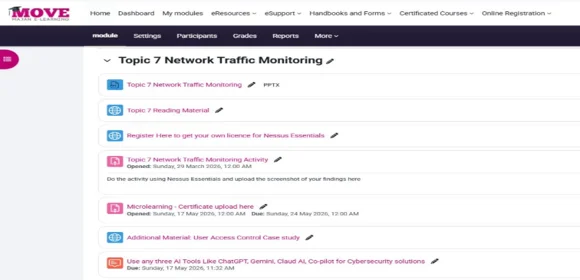
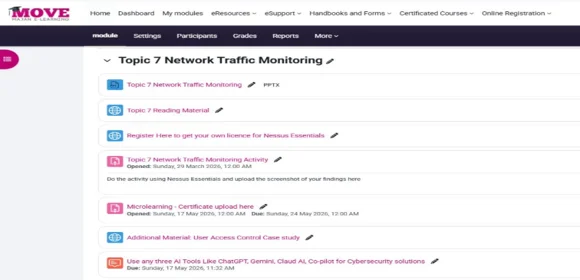
Figure 1 — Topic 7: Network Traffic Monitoring on MOVE (Majan E-Learning), showing Nessus Essentials registration, microlearning certificate upload, and the AI tools forum activity.
Step 2: Comparing AI Tools in Problem Solving
Once vulnerabilities were identified, the next challenge for students was not just to remediate them, but to analyze the suggested solutions from multiple AI tools like ChatGPT, Google Gemini, and Claude AI. This comparative analysis sparked rich discussions, revealing that different tools provided varied insights and depths in their remediation strategies. For instance, one student’s examination of a critical vulnerability highlighted the differences in effectiveness between the tools.
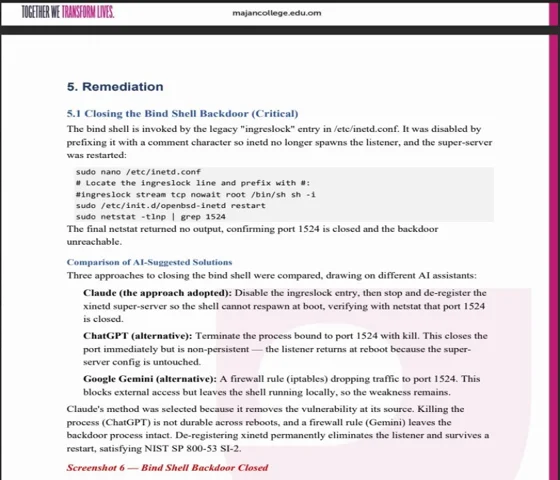
Figure 2 — A student’s submitted report comparing Claude, ChatGPT, and Gemini remediation approaches for a critical bind shell backdoor vulnerability discovered using Nessus Essentials.
Through these exercises, students not only engaged with AI’s potential but also developed critical evaluation skills vital for navigating the complexities of cybersecurity threats.
Step 3: Microlearning to Enhance Lab Preparation
To support the lab sessions and AI analyses, a shift to microlearning was implemented. Traditional lengthy lectures were replaced with short, focused learning units delivered on the e-learning platform, MOVE. Each unit was crafted to introduce key concepts in under ten minutes, allowing students to come to lab sessions better prepared for practical application. This format catered to students' busy lives, making it easier to engage with materials during commutes or in shorter time frames.
Positive Outcomes and Student Engagement
The results of this AI and microlearning integration were noticeable. Students demonstrated remarkable improvement in performance during practical assessments focused on vulnerability identification. Feedback reflected increased confidence in their abilities to use tools effectively, along with higher levels of engagement in peer discussions. Students previously struggling with abstract concepts actively contributed to discussions, indicating that hands-on, relevant experiences were leveling the playing field in understanding cybersecurity.
Key Insights for Educators
This approach yields several valuable lessons for other educators:
- Start with Real Tools: Utilize industry-standard tools like Nessus Essentials to foster genuine connections with the subject matter.
- Promote AI Literacy: Rather than solely allowing AI use, require students to critically evaluate AI-generated solutions to enhance their analytical skills.
- Adopt Microlearning: Limit content delivery to concise, single-topic units that pair seamlessly with practical lab tasks to reinforce learning.
In cybersecurity education, it’s not just about imparting knowledge about threats. It’s about training students to think critically and act responsively amid a rapidly evolving threat landscape, especially with AI tools at their disposal. This methodology, which began as an experiment, has reshaped teaching practices and established a new standard for engaging students in cybersecurity learning.
This summary reflects findings presented in a peer-reviewed article: A Pedagogical Framework for Embedding Microlearning, Gamification, and Industry Credentials in Undergraduate Cybersecurity Education — Ramalingam Dharmalingam, Majan University College, Muscat, Sultanate of Oman.
Dr. Ramalingam Dharmalingam is an Assistant Professor in Faculty of IT at Majan University College, Muscat, Oman. His research focuses on cybersecurity education, AI-assisted learning, and enhancing pedagogical frameworks for technology modules. He is a Senior Fellow of the Advance HE, UK, and a Senior member of IEEE. Connect with him on LinkedIn.


Discussion
Sign in to join the discussion.