PISA data reveals mixed effects of generative AI on student learning, highlighting the need for careful implementation and pedagogical strategies.
By OECD Director for Education and Skills Andreas Schleicher
The swift integration of generative artificial intelligence (AI) into educational environments is undeniable. Recent findings from the Programme for International Student Assessment (PISA) indicate that a significant number of students globally are leveraging AI tools for school assignments. In jurisdictions like Macao (China), Thailand, and Viet Nam, upwards of 40% of students utilize AI to craft their writing tasks multiple times a week, with Vietnam leading at an impressive 52%. Such statistics signal a noteworthy trend in academic practices across multiple regions.
Teachers, many of whom have turned to AI for crafting lesson plans and grading, have observed a shift in student submission quality, raising pertinent concerns about academic integrity and the essence of authorship. There’s an urgent question here: is AI enhancing educational outcomes, or is it contributing to a decline in genuine learning?
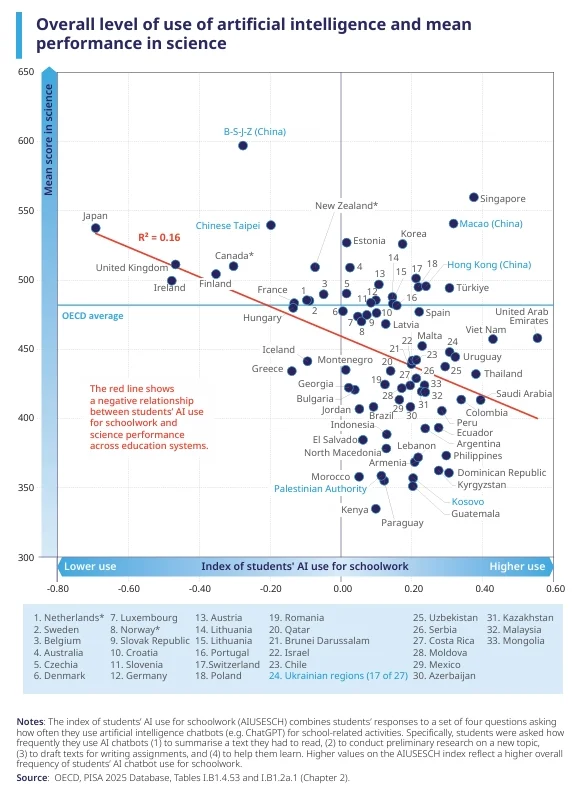
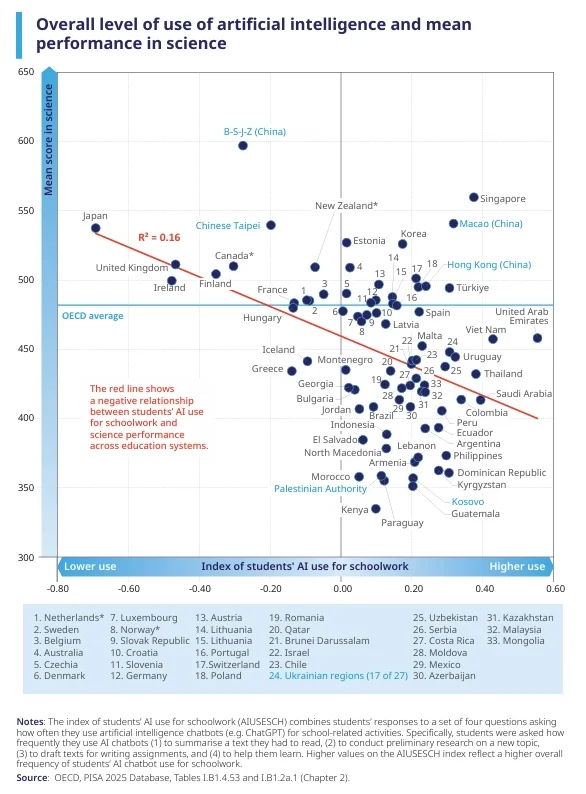
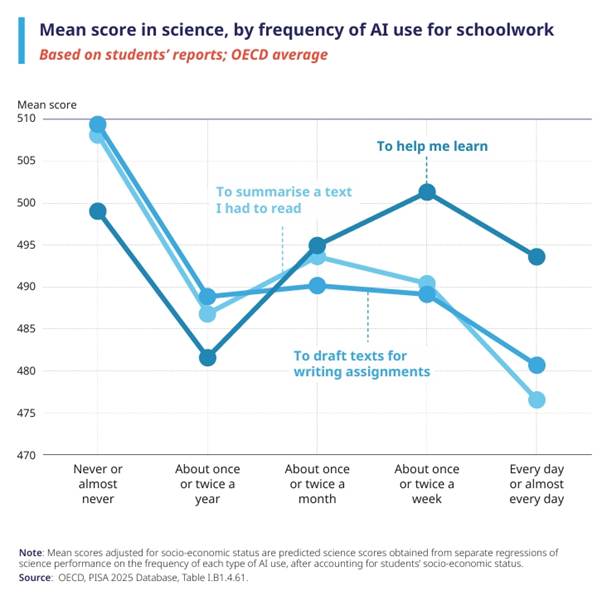
Initial data from PISA offers a somewhat concerning narrative. Students who frequently utilize AI chatbots tend to score lower in science assessments compared to their peers who abstain from such tools. The gap can be substantial — around 20 points on average, which equates to a full year of schooling difference. In countries like Canada and New Zealand, the discrepancies are even more pronounced, with reported decreases of 29 and 36 points for regular AI users, respectively. Interestingly, students who refrain from using AI for specific tasks also exhibit a greater tendency toward self-regulated learning strategies.
Nonetheless, the relationship between AI use and academic performance isn't straightforward. In certain contexts, such as Thailand and Macao, students engaging with AI for assignments weekly or daily have outperformed their peers. Additionally, usage patterns are significant; those employing AI tools judiciously — perhaps once or twice a week — perform comparably to non-users across OECD countries. This suggests that the effectiveness of digital tools hinges on thoughtful selection and frequency of use. Overuse, or reliance without guidance, may distract and disengage students, subsequently affecting their learning trajectory.
Examining patterns in high-performing education systems reveals more complexity. Countries like Korea and Singapore, which boast top-tier science scores, benefit from robust policies fostering digital learning, including AI integration. In contrast, nations like Japan and Estonia achieve high PISA test scores but see limited AI application in their educational practices.
The data prompts essential discussions about AI's role in education. Advocates have suggested that AI can tailor learning experiences, provide immediate feedback, and aid educators in pinpointing learning deficiencies. However, current evidence does not unambiguously support these claims.
According to the OECD’s Digital Education Outlook, specialized educational GenAI tools can enhance learning over time, while general-purpose tools often fail to contribute to deep learning experiences. Researchers warn that over-reliance on AI may result in cognitive offloading, leading to decreased engagement and effort.
The situation becomes dire when juxtaposed against the cautious scrutiny necessary for other domains, such as healthcare. Countries typically wouldn’t introduce new vaccines without extensive testing; paradoxically, educational technologies are sometimes deployed at scale without substantive evaluation. This tendency illustrates a troubling aspect of edtech: we often test these tools on students before confirming their efficacy. The fact that AI is prevalent in classrooms does not negate evidence suggesting it could hinder learning outcomes.
Looking ahead, it's clear that educational authorities have a vital role in establishing frameworks for AI implementation within schools. Guidelines must address pedagogical value, age appropriateness, academic integrity, and data privacy. Resources like the OECD-EU AI Literacy Framework provide a strong foundation for these discussions.
Moreover, teachers require ongoing training to navigate AI's capabilities and its limitations effectively. Without adequate support, there’s a real danger of educators either overdependently leveraging AI or completely dismissing beneficial applications.
Most critically, stakeholders in education must remain cognizant of the limitations inherent in generative AI. Thoughtfully applied, AI can provide insights and challenges that facilitate learning. However, if misused, it may offer shortcuts that undermine essential cognitive development aimed at fostering independent thinkers. The potential for widening educational disparities is a legitimate concern that can't be overlooked. Until we gather stronger evidence showing AI's efficacy, a cautious approach is advisable for both students and educators alike.
This blog is based on a chapter from the PISA 2025 Insights and Interpretations brochure
Note: An asterisk (*) by the name of a country or economy indicates caution is required when interpreting these estimates because one or more PISA sampling standards were not met (refer to the Reader’s Guide of the PISA 2025 Results Volume I).


Discussion
Sign in to join the discussion.