Discover the key elements that differentiate impactful learning experiences, emphasizing personal significance, engagement, and constructive feedback.
Not every educational experience sparks genuine learning, and there's a crucial question here: What distinguishes those that do from those that don’t? The answer lies in the personal significance and authenticity of the experience itself.
In my years teaching a doctoral program titled “The Power of Experiential Learning,” I often encounter seasoned educators who walk into the classroom confident in their understanding of experiential learning. Yet, by the end, a common refrain emerges: “I thought I knew what experiential learning was, but I really didn’t.” This realization underscores a profound gap in understanding how we learn effectively.
For the first three weeks of the course, I dispense with conventional readings. Instead, I encourage participants to reflect on their own journeys, asking them to identify three deeply impactful learning experiences alongside three that were lackluster. They discuss these experiences in small groups, pinpointing the elements that contributed to their learning.
What emerges from these conversations is enlightening. Here are a few key factors that participants highlight as essential for impactful learning experiences:
1. Immersion in topics that resonate personally and hold significance.
2. The chance to engage in hands-on activities, succeeding and failing in authentic tasks along the way.
3. Receiving constructive feedback from knowledgeable mentors who can guide their learning.
4. Building relationships with peers or mentors—connections consistently shown to foster engagement and achievement [see research](https://eric.ed.gov/?id=EJ1156223).
Yet, there’s a stark contradiction at play. Throughout this process of discovery, many educators reflect on a shared frustration: the learning experiences they’ve had in school and professional development often rank among the least valuable. In fact, a 2024 Gallup survey of over 4,000 young people ages 12 to 27 found that less than 20% felt their classroom learning was interesting or relevant to their strengths [read more](https://news.gallup.com/poll/648896/schools-struggle-engage-gen-students.aspx). It’s disheartening to realize that the very environments—schools and professional training—designed to nurture our growth often fall short.
This raises a troubling question: if our educational and professional development settings are meant to foster significant experiences, why are so many individuals left feeling that their time there lacked impact?
Moving forward in this inquiry demands us to deeply consider what types of experiences ignite real learning and how they transform the way participants think and act in their respective fields.
### The Role of Kolb’s Learning Cycle
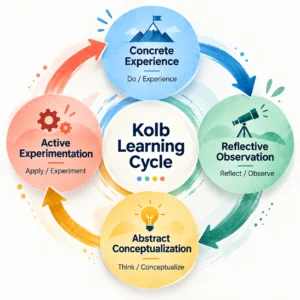
When educators discuss experiential learning, they often reference David Kolb’s model, which outlines a cyclical process: we engage in experiences, reflect on them, conceptualize our learnings, and apply that knowledge to new contexts. While Kolb highlights the importance of both hands-on experiences and reflection, he stops short of specifying which types of experiences yield high-impact learning. That distinction is fundamentally important.
Kolb insists that merely having experiences isn’t enough; real learning occurs when we actively transform those experiences through reflection and application. Sustained, meaningful learning is an iterative journey rather than a one-off event.
Rethinking Student Engagement
Most educational environments aren’t constructed to inspire students through authentic, interest-driven projects supported by mentors. Despite the intent to innovate, a comprehensive six-year study on thirty forward-thinking high schools revealed that genuine, immersive learning opportunities are more of an exception than a norm. This shortfall creates significant hurdles for educators striving to capture students’ imaginations and foster deeper learning. Traditional structures—typically defined by 45-minute class periods and rigid subject boundaries—severely limit teachers' ability to creatively engage students in meaningful, real-world pursuits.
The schools breaking this mold adopt distinctly different designs, which often involve extended class periods that allow for rich engagement in hands-on activities, coupled with proactive mentorship and real-world internships. While it's imperative to cover a curriculum that includes essential knowledge and skills, the prevailing educational model prioritizes rote learning over experiential learning that is fueled by student interest. This traditional approach focuses on mere content delivery rather than crafting experiences that resonate with students' lived realities.
The Knowledge-Action Gap
Consider this scenario: a student can memorize the intricacies of a driver’s manual and pass a written exam. While this factual knowledge is helpful, it doesn’t translate to actual driving ability. Skillful driving requires real-time experience behind the wheel: mastering acceleration, braking, turning, and the nuanced ability to anticipate the behavior of other drivers. Anyone who’s guided a novice through this process is acutely aware of the stark difference between theoretical knowledge and practical competence.
Unfortunately, the bulk of current educational practice resembles this scenario where students predominantly “learn” through passive means. They might engage in memorization and recall through quizzes and papers, but these activities don’t guarantee that they will effectively apply what they've learned in complex and unfamiliar situations. The challenge here is the concept of transfer: students often struggle to see when knowledge applies to different contexts. They need multiple opportunities to practice skills in varying situations and receive constructive feedback to gauge their progress.
Effective learning involves more than just exposure to information. It necessitates students recognizing commonalities between different situations and adapting their knowledge accordingly. This is not to undermine conventional methods like direct instruction and assessments, which are still vital. However, when the priority is on fostering genuine skills such as problem-solving, collaboration, and critical thinking, mere knowledge transmission falls short. Situated cognition research supports this point by demonstrating how tightly woven knowledge is with the contexts in which it is developed and utilized. Strip knowledge from authentic settings and you diminish both its significance and its applicability to real scenarios.
Learning as a Continuum
Designing effective learning experiences requires understanding them as a continuum. This ranges from simple knowledge transfer to engaging students in authentic work that has real consequences. An example of this is captured in a model proposed by Getting Smart, which outlines various experiences students can encounter.
In terms of the experience continuum:
- **Basic knowledge communication** involves tasks like reading and memorizing, akin to studying a driver’s manual.
- **Distant proxies** might include simplified tasks that vaguely resemble actual work, a bit like playing a driving simulation game.
- **Close simulations** provide practice in a controlled, realistic context, such as learning to drive in an empty parking lot.
- **Authentic practice** requires students to apply their knowledge in real-world situations where mistakes matter, much like driving on actual roads with real traffic.
While these categories aren’t strictly hierarchical, they emphasize the idea that not all experiences drive meaningful learning. Insight from educational theorist John Dewey underscores that mere experience doesn’t equate to education; its value hinges on the context and the productive connections it makes to prior and future learning. Traditional knowledge transfer and simulations have value as foundational layers, but they cannot replace authentic practice when the goal is to cultivate real-world competence. A well-designed learning environment should facilitate movement across all four categories, striving to immerse students in genuine work whenever possible.
Redefining Authentic Learning
When we talk about authentic learning, we need to interrogate the very essence of what we're creating. It's not enough to label a project as "experiential"; we should be asking critical questions: What purpose does this exercise serve beyond mere task completion? Are students genuinely engaging with disciplinary knowledge, or merely applying it superficially? Who are the intended audiences for this work, and how will they interact with it? How are students receiving constructive feedback to improve continuously? Furthermore, how are they reflecting, both individually and collectively, on their experiences and future paths?
The standout schools redefining education don’t relegate this kind of learning to an optional program or a special end-of-year event. They cultivate a structured trajectory where learners acquire knowledge, observe experts, practice with guidance, tackle progressively challenging and real-world tasks, receive feedback, and reflect on their growth. This ongoing development fosters intrinsic engagement, leading to independent thought and creativity. The distinguishing factor between institutions that teach facts and those that empower students to apply their knowledge effectively lies in this progression, which I refer to as the “Cool Schools.” So, does your institution embody the spirit of a "Cool School"?
The Importance of Experience in Learning
Here's the crux: just being active in the classroom doesn't guarantee that students are absorbing the necessary knowledge and skills. True understanding arises when they apply what they've learned in ways that matter to them—through genuine motivation and relevance. We're not just looking at academic prowess; we're aiming to nurture cognitive, interpersonal, and intrapersonal skills that enable learners to translate their knowledge into action within meaningful contexts. Continuous feedback and opportunities for personal reflection are essential in this growth process.
Ultimately, this ambitious aspiration should guide our educational endeavors. It’s imperative that we focus on how we can enhance the experiences we offer young people today, ensuring they evolve into adept individuals prepared for their future challenges.
For those looking to refine their approach, consider downloading the helpful
Experience Quality Rubric, which can serve as a tool to assess and improve the impact of experiential learning within your institution.


Discussion
Sign in to join the discussion.