Buckminster Fuller proposed a geodesic dome for Manhattan in the 1960s, aiming to transform urban living and environment management amid concerns of overpopulation and pollution.
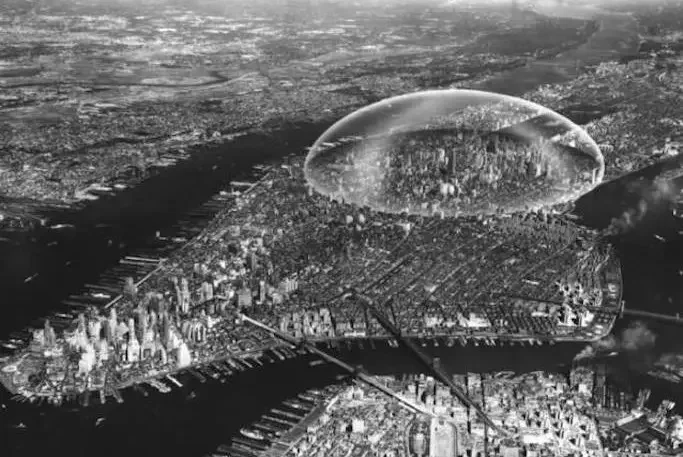
Image via Buckminster Fuller Estate
A Bold Proposal for Urban Transformation
In the early 1960s, visionary architect Buckminster Fuller and his collaborator Shoji Sadao proposed an ambitious plan to cover Manhattan with a two-mile-wide geodesic dome. This concept aimed not just to shelter the city but to fundamentally alter how its residents would interact with their environment. At its core, Fuller's vision was a response to the rapid urbanization and resource depletion the world faced, reflecting a deep-seated desire for transformation in how cities operated.
Fuller and Sadao described the dome as an architectural marvel designed to boost the city’s ecological efficiency. Their calculations suggested that the dome could minimize heat loss significantly by reducing the exposed surface area of the city to just one eighty-fifth of its usual size. This reduction would lead to substantial energy savings — essentially paying for itself by eliminating the need for snow removal and enhancing the performance of buildings inside. This kind of architectural thinking connects back to our ongoing struggle with energy consumption: today’s technologies still grapple with similar challenges as more urban areas look for efficiency improvements.
Moreover, the design promised a variety of conveniences: cars and lawns would remain pristine, thanks to the dome's one-way glass, which would shield residents from prying eyes and harsh weather. Fuller clearly understood the fears and aspirations of America in the 1960s, where a belief in technology as a solution to many societal ills was strong. Sam Lubell, co-author of Never Built New York, emphasizes that the era was marked by an optimistic view of technological advancement, as people were already witnessing progress like moon landings. Thus, the dome was not merely a shelter; it represented hope and the possibilities inherent in our relationship with technology.
Challenges and Realities
Despite its visionary appeal, Fuller acknowledged the complexities involved in such a grand project. He recognized the challenge of ownership rights in a city as densely packed and diverse as New York—landholders might resist the idea of a dome obstructing their sky. “It’d be very worthwhile to have cities under geodesic domes... but New York City... with all the different owners of different lands... I just don’t think it’s going to happen,” he noted. This insight speaks volumes about the often unseen battles that occur behind urban development projects, where aspirations clash with legal and financial realities.
Back then, the increasing demands on resources from a rapidly growing population were viewed as a pressing concern. While many of Fuller’s ideas seemed ambitious, subsequent developments such as advancements in energy efficiency have led to new paradigms in urban planning, shifting priorities and perspectives on urban living. The ongoing relevance of Fuller's concepts indicates that they may not have been entirely impractical even if they were unfeasible at the time. Today, cities are still grappling with aging infrastructure and environmental changes, making Fuller's ideas worth revisiting.
Enduring Relevance of Fuller’s Ideas
Fuller’s vision, while seemingly eccentric, points to a longing for solutions to urban challenges that are still relevant today. His ideas on constructing shelters that harmonize with human needs echo in contemporary discussions about sustainable living and urban design. The principles he championed—like reducing waste and enhancing efficiency—are at the forefront of today’s smart city initiatives. Interestingly, Fuller’s blend of utopian hopes and pragmatic concerns reflects ongoing debates on how to manage future urban spaces. This work lives on in discussions about eco-cities and sustainable architecture.
This imaginative proposal for a dome over Manhattan serves as a reminder of the delicate balance between aspiration and practicality in urban planning. The interplay between humanity’s needs and environmental stewardship continues to inspire architects and urban planners alike, as they navigate the complexities of urban density, climate change, and technological possibilities. If you’re working in this space, contemplating the relationship between built environments and ecological necessity, Fuller’s legacy feels prescient.
Implications and Future Outlook
The implications of Fuller's vision stretch beyond mere nostalgia; they invite us to reconsider how urban environments can adapt to changing circumstances. The urgency of climate change and ongoing urban challenges makes innovation essential. But here’s the thing: while technology progresses, the fundamental issues of governance, resource management, and community engagement remain underlining challenges. What this means for you, as a stakeholder in urban development, is straightforward—technological achievements will have limited impact without thoughtful planning and community buy-in.
For architects and planners today, revisiting ideas like Fuller’s dome can inspire new methods of urban design. As we confront an era marked by environmental uncertainty, such visionary frameworks can serve as springboards for reimagining our cities. The dome’s conceptual legacy reinforces the pressing need for a synthesis of aspiration and practical implementation in urban innovation—one that reflects the complexities and nuances of modern life. (And this is the part most people overlook.) Perhaps Fuller’s true genius lies not just in the specifics of his ideas, but in the imaginative capacity to envision possibilities that push us to rethink how we structure our urban experiences.
Related content:
The Life & Times of Buckminster Fuller’s Geodesic Dome: A Documentary
A Brief Introduction to Buckminster Fuller and His Techno-Optimistic Ideas
The Eden Project Built a Rainforest Ecosystem Inside Buckminster Fuller-Inspired Geodesic Domes
Better Living Through Buckminster Fuller’s Utopian Designs: Revisit the Dymaxion Car, House, and Map
Based in Seoul, Colin Marshall writes and broadcasts on cities, language, and culture. He’s the author of the newsletter Books on Cities as well as the books 한국 요약 금지 (No Summarizing Korea) and Korean Newtro. Follow him on the social network formerly known as Twitter at @colinmarshall Marshall.

Discussion
Sign in to join the discussion.