Global reading scores have markedly declined, revealing systemic issues in education and a worrying trend in students' engagement with complex texts.
By OECD Director for Education and Skills Andreas Schleicher
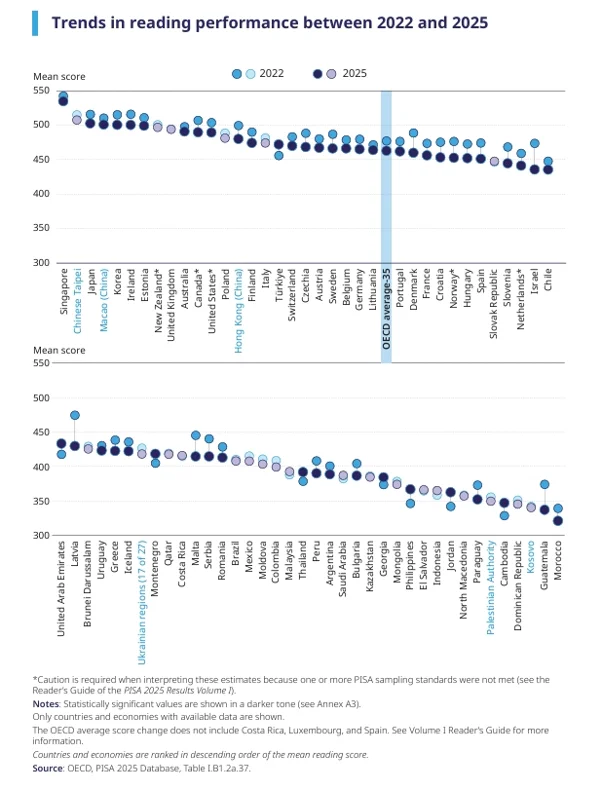
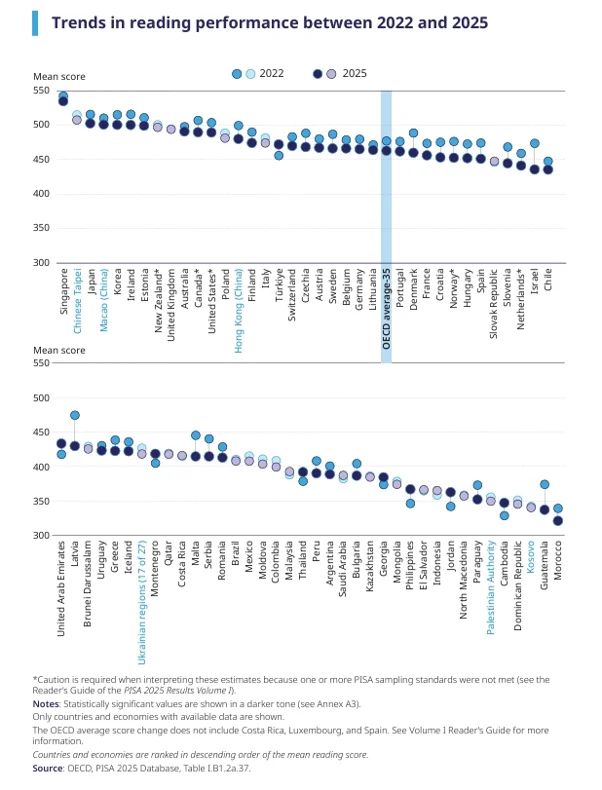
The latest Programme for International Student Assessment (PISA) findings reveal alarmingly low global reading scores, with three-quarters of countries showing significant declines between 2018 and 2025. Out of 74 education systems assessed, 56 experienced drops, leading to an average decline of 25 score points across the OECD. Notably, countries like Iceland and Slovenia registered declines exceeding 50 points. This decrease equates to a year of educational regression, placing many 15-year-olds at reading levels typical for 14-year-olds.
Conversely, a few nations managed to achieve reading score improvements despite the overarching negative trend. Qatar rose by 11 points, Brunei Darussalam by 18 points, Cambodia by 26, the Philippines by 27, and Zambia made a remarkable gain of 50 points. Although these countries still lag below the OECD average, their progress amidst a global downward trend deserves acknowledgment.
The disheartening trend in reading scores invites a deeper analysis, especially since reading proficiency significantly influences performance across other subjects. Upon closer inspection of student responses, it appears that while gender gaps and discrepancies between immigrant and non-immigrant students remained steady, many students struggled particularly with longer texts that demand higher cognitive abilities. Such tasks require sustained attention, critical thinking, and the ability to synthesize information effectively.
Another notable trend is the increase in students reading hastily. Between 2018 and 2025, instances of quick but inaccurate reading responses nearly doubled to 9%. In Kosovo, the Dominican Republic, and Bulgaria, the rate exceeded a 10 percentage point increase. Students from these areas also indicated higher levels of digital distractions compared to the OECD average.
This rise in superficial reading habits aligns with a growing dependence on digital formats. While it’s difficult to establish a direct correlation, the habitual skimming of social media content and consuming information at a rapid pace seem to contribute to diminishing the motivation and ability to engage with intricate texts. Reports indicate that since 2022, the percentage of students spending over an hour daily on social networks has surged by almost six points, likely exacerbating reading challenges.
COVID-19 and resultant school closures have also had detrimental effects on reading performance. However, early data suggests that the root issues predate the pandemic. By comparing PISA outcomes with the Progress in International Reading Literacy Study (PIRLS), which examined younger students in 2016 and 2021, one can identify an alarming trend. Many students from the 2016 cohort taking the PISA assessments later showed a decline in reading skills that was already evident at 9- to 10-year-olds, implying that foundational issues have been affecting students since their early educational experiences.
Further analysis indicates that students' efforts in PISA assessments decreased by 2025 compared to earlier years. Their curiosity about various subjects also waned, particularly in regions where reading scores fell most dramatically. Moreover, countries reporting an increase in students viewing school as a “waste of time” coincidentally witnessed substantial declines in reading performance. Though correlation doesn't entail causation, these factors frame the broader context of the troubling trends.
Perhaps surprisingly, the data suggest that socio-economic status also played a role in the decline. The highest-performing quarter of students actually experienced the steepest drops in reading ability. This counterintuitive finding points to a widening gap where students from more privileged backgrounds are underperforming compared to their potential. The average discrepancy between the most advantaged and disadvantaged students diminished from 88 points in 2018 to 77 points in 2025 across 35 OECD countries.
In sum, the pervasive downward trend in reading scores primarily reflects a decline in students' focus and commitment to reading and learning. Policymakers face the pressing challenge of reigniting interest in reading among youth—an endeavor that’s increasingly difficult in an age where many adults have also lost their enthusiasm for reading.
This blog is based on a chapter from the PISA 2025 Insights and Interpretations brochure:



Discussion
Sign in to join the discussion.