Educators are reintroducing oral exams as a response to AI's influence on assessments, emphasizing understanding over mere output.
Reassessing Assessment Methods
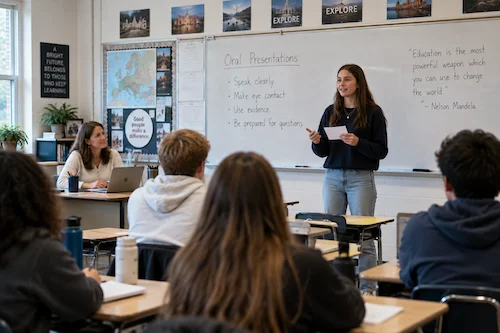
As generative AI continues to permeate educational spaces, one traditional method is experiencing a resurgence: the oral exam. This shift, pivoted by challenges posed by AI, is spearheaded by educators like Catherine Hartmann from the University of Wyoming. As AI-generated content becomes indistinguishable from a student’s original work, relying solely on written submissions is increasingly problematic. That’s why Hartmann has shifted to a model focusing on verbal assessments that prioritize student comprehension and articulation, emphasizing the need for genuine understanding rather than surface-level regurgitation of facts.
Reconstructing the Learning Experience
In her redesigned courses, Hartmann doesn’t simply replace written assignments with oral examinations. Instead, she employs backward design to scaffold the entire educational experience. This approach necessitates intentional planning that starts with the desired outcomes and works backward to ensure alignment in teaching methods and assessments. Throughout the semester, students engage in discussions that challenge them to articulate complex concepts and reasoning. This continuous practice culminates in a final oral exam that not only assesses their knowledge but also reflects their development throughout the course. Such an assessment ensures that students can demonstrate their learning journey, which is far more indicative of their understanding than a single written product.
Understanding Through Conversation
The resurgence of oral exams brings a paradox to light: amidst the technological advances disrupting education, centuries-old assessment practices can appear remarkably relevant. Generative AI has not rendered traditional assessments pointless; it has prompted educators to reconsider what constitutes tangible evidence of learning. For instance, at the University of Pennsylvania, mathematics professor Robin Pemantle assesses student understanding in real-time through oral dialogue during problem-solving sessions. This dynamic approach enhances the assessment of critical thinking skills, offering immediate feedback that written tests cannot replicate. Students can articulate their reasoning processes and classmates can engage in discussions that provide a deeper understanding of the material. This reflects a broader trend in education where conversation is increasingly recognized as a powerful tool for learning.
The Dynamics of Oral Assessments
This renewed focus on oral examinations extends beyond merely identifying students who misuse AI. The deeper opportunity here is to re-evaluate the objectives of assessments. Written essays can indicate a final outcome, but oral exchanges provide insight into the thought processes behind these results. Such interactions allow educators to detect misconceptions during discussions, offering a chance to challenge students and assess their adaptability beyond rote memorization. It’s in these exchanges that the real learning occurs. This kind of dialogue enables instructors to uncover not only what students know but also how they think, fostering a richer educational experience.
Embracing AI's Role in Learning
AI tools can still play a role in this learning process. Students might utilize AI to brainstorm ideas or refine their thoughts leading up to an assessment. The critical inquiry evolves from whether AI influenced a student’s work to whether the student can genuinely claim ownership of their content and understanding. This shift invites students to engage with technology in a thoughtful way, turning AI into a partner rather than a crutch. The emphasis is on how AI can enhance critical thinking and creativity, rather than simply replacing human effort with algorithm-driven solutions.
Fostering Equity in Oral Exams
However, reintroducing oral assessments necessitates careful planning. Not all students possess the same comfort or skill in verbal communication, particularly multilingual learners. Factors such as language processing speed or vocabulary retrieval should not be misinterpreted as a lack of comprehension. The goal of assessing reasoning and understanding must ensure language facilitates communication rather than obstructs it. Educators must create an environment where all students feel empowered to express their thoughts. This may mean integrating varied assessment strategies that consider different backgrounds and capabilities, ultimately leveling the playing field for everyone involved.
Building Preparation into the Process
Hartmann’s methods emphasize that preparation for oral assessments shouldn’t be confined to exam day. Students require low-stakes opportunities throughout their learning journey to practice discussion and reasoning. This ongoing practice helps diminish anxiety surrounding performance in a high-pressure setting. Ultimately, evaluations should reflect a student’s ongoing engagement with the material rather than an isolated performance under pressure. By nurturing skills like verbal articulation over the course of the term, educators can foster competencies that benefit students well beyond their formal education.
Blending Traditional and Modern Assessment
The revival of oral exams does not imply the complete dismissal of written assignments such as essays or research papers. Instead, the focus is on diversifying what constitutes evidence of learning. While a written paper elucidates what a student has produced, an oral exam can illuminate the student’s understanding and reasoning process. This dual approach not only enriches the assessment process but also enables educators to engage with students on multiple levels, ensuring a fuller picture of student learning.
Implications for Future Assessment Strategies
This is why the oral exam feels newly relevant: as machines become adept at generating answers, assessments must evolve beyond mere artifact collection to capture the complexity of human thought and understanding. If you're working in this space, consider what these changes mean for curriculum design and student engagement. Rethinking assessment strategies can lead to more meaningful educational experiences. History shows that education often swings between technological reliance and traditional practices, and right now, we’re at a tipping point that might just redefine how we evaluate learning outcomes. The challenge will be balancing innovation with effectiveness, ensuring that both students and educators thrive in this new paradigm.



Discussion
Sign in to join the discussion.