Effective educational institutions harness distinct strategies for addressing challenges through implementation, innovation, and continuous improvement.
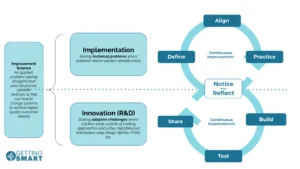
Strategic educational organizations are rethinking their approaches to solve persistent challenges. Through partnered observations in various states like Virginia and Michigan, it's clear that successful schools are adept at aligning their methods with the specific challenges they face. As discussed in earlier explorations, high-functioning institutions do not rely on a one-size-fits-all strategy; instead, they discern when to implement known solutions, when to innovate for novel problems, and when to focus on iterative improvement.
Mastering Three Key Approaches
High-performing educational institutions typically excel through three primary strategies:
- Directional Strategy: This involves a Strategic Direction formed by distinct priorities and related goals, undergirded by financial models that facilitate change initiatives.
- Operational Strategy: Schools employ an R&D approach to tackle adaptive challenges while using established Implementation protocols to manage technical challenges. Both strategies incorporate clear Success Metrics to evaluate effectiveness.
- Relational Strategy: A thoughtful approach to Leading Change is essential, built on trust, clarity, and focused efforts.
Understanding Implementation Science
Implementation Science is the framework that guides the adoption of established, evidence-based practices within educational systems. Examples encompass methodologies like Multi-Tiered Systems of Support (MTSS) or specific curricula. This scientific approach places a premium on technical challenges where solutions are documented and known. Achieving high-quality implementation is critical; however, organizations must balance structure with an understanding of the unique context and needs of their educational communities.
While structured implementation is beneficial for known problems, it might lead to an overly compliance-focused environment, which can stifle the adaptive creativity necessary for educational success.
The Role of Innovation
Innovation comes into play chiefly for adaptive challenges—situations where traditional solutions don’t suffice. It focuses on questions that remain unanswered and necessitates creative problem-solving strategies. This includes areas such as meaningful assessments or co-designed educational experiences. Tools like Design Sprints, employed by organizations such as IDEO and the Stanford d.school, help educators cultivate innovative thinking. Yet, it's important to note that effective innovation often requires adaptive shifts within the organizational culture and classroom dynamics.
Educational leaders have a pivotal role in fostering a conducive environment for innovation. They need to cultivate conditions that support experimentation, allow the exploration of new ideas, and judiciously decide when a concept is ready for broader implementation.
Navigating Improvement Science
The third element, Improvement Science, intertwines the realms of Implementation and Innovation. It leverages tools like PDSA cycles and Action Research to assess and refine practices. This approach involves rapidly testing initiatives to confirm their effectiveness in real contexts. For instance, while implementing a new curriculum, a PDSA cycle can gauge its success and foster necessary adjustments to enhance student outcomes. Similarly, during the innovation phase, continual improvement models help refine ideas based on ongoing feedback.
Integrative Strategies for Success
The intersection of these three methodologies creates a comprehensive learning environment. Implementation addresses known solutions, Innovation introduces new practices, and Improvement evaluates their efficacy in context. This layered approach allows schools and districts to sharpen their focus and enhance clarity on the right tools for specific challenges.
For instance, when noticing consistent attendance issues among high school students, a well-defined Communities in Schools implementation could be the appropriate response. Meanwhile, middle school educators might opt for a Design Sprint to better engage students struggling in math.
The Path Forward
Organizations deeply rooted in an implementation-focused mindset may benefit from shifting towards fostering agency and grassroots innovation. Conversely, institutions overly preoccupied with innovation may require training in implementation to effectively scale promising new methods. The educational sector often complicates models and processes without recognizing their potential simplicity. The focus should be on discerning the challenges at hand and matching them with the corresponding responses—whether that means deploying familiar strategies or pioneering new approaches.
The ultimate goal is a system adept at determining when to implement, when to innovate, and when to improve, all while maintaining the capacity for effective execution across all three dimensions. The success of educational institutions hinges on the ability to navigate these strategies optimally, leading to improved outcomes for every student.
By strategically defining these processes, schools enhance learning outcomes and create environments conducive to growth and success for all stakeholders involved.


Discussion
Sign in to join the discussion.