A shared vocabulary can enhance collaboration in educational transformation, revealing common goals across diverse frameworks.
The ongoing development of school transformation frameworks highlights a diverse array of design principles tailored to specific needs. Over the years, various school systems and organizations have crafted distinct methodologies, reflecting their unique missions and values.
What’s fascinating is not the variety itself, but the commonalities that often emerge from these different approaches. Teams frequently find themselves expending energy translating similar concepts into different terminologies, leading to more confusion than clarity. As education leaders collaborate with diverse stakeholders, a pivotal question arises: Is there a unifying framework underlying these various approaches?
It turns out, there is. What we discovered is a surprisingly consistent return to a common set of inquiries underpinning these frameworks. No matter how unique the terminology or visuals, the fundamental architecture of these frameworks points towards shared elements.
Inspired by Sangeet Paul Choudary’s insights on coordination, as discussed in his book Reshuffle, we believe that identifying these core components could accelerate efforts in school transformation. This isn’t aimed at replacing existing ideologies, but rather at cultivating a shared vocabulary that can streamline collaboration across the educational sector.
The Core Architecture: Seven Essential Questions
We present the Learning Innovation Wayfinder, which encapsulates school transformation into seven critical questions, each designed to steer discussions and decision-making.
| Element | Guiding Question | What It Covers |
| WHY Community Vision |
Why are we making this change? | Community Need, Mission, Vision, Values & Norms |
| WHAT Learner Outcomes |
What should our learners know and be able to do? | Learner Portrait, Standards, Competencies, Learning Progressions, Educator & Leader Portraits |
| HOW Learning Model |
How is the learning experience designed to support reaching the Learner Outcomes? | Climate & Culture, Design Principles, Learning Experience, Instruction & Facilitation, Assessment, Professional Learning |
| FOR WHOM Signals |
For whom is student proficiency and learning translated? | Reports, Portfolios, Transcripts, Credentials |
| WHERE Learning Ecosystem |
Where will learning occur and what operational structures will support learning? | Technology, Facilities, Staffing & Scheduling, Transportation, Partnerships, Networks |
| WHEN Strategy |
When will this work happen? | Strategic Direction, Leading Change, Finance, Implementation, Measuring Success, Research & Development |
| WHAT NEXT Impact & Scaling |
What’s next to accelerate impact on more learners? | Codifying, Sharing, Landscape Analysis, Theory of Change, Scaling |
While communities don’t always approach these questions in a linear fashion, nearly all transformative initiatives eventually loop back to them. Specific frameworks often provide clarity and direction that facilitate these conversations, wherein the ultimate aim is not just alignment but coherence that directly benefits learners.
Insights from the Transformation Ecosystem
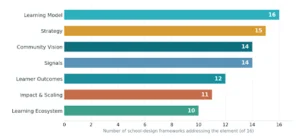
A comparative study involving 16 major school-design frameworks and 7 notable change and improvement models offered deeper insights into a shared language for transformation. This analysis predominantly drew from publicly available resources to ensure accessibility.
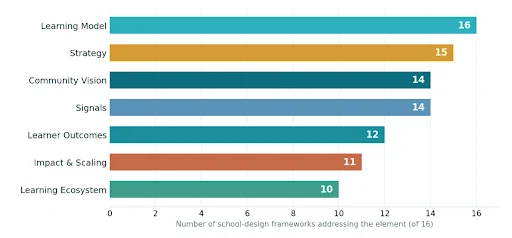
Figure 1. A crosswalk of leading school-design frameworks and change & improvement models
Prepared by Getting Smart · 2026
Our findings reveal that every analyzed framework incorporates elements of the shared architecture, emphasizing that while differences can create distinct value, they also enhance the collective understanding of educational transformation. We gleaned several key takeaways from our analysis:
- The Learning Model is Universal: Every examined framework reflects how students achieve proficiency.
- Vision, Strategy, and Signals are Centered: Most frameworks emphasize strategic vision-setting and implementation, highlighting the central role of community vision.
- The Learning Ecosystem is the Thinnest: Only about 63% of frameworks adequately specify where learning environments exist and what resources support them.
- Process Meets Content: Insights drawn from change models align closely with three primary elements: Community Vision, Strategy, and Impact & Scaling.
This wayfinding language effectively balances the content of transformation with the process of achieving those goals.
Importance of a Shared Architectural Framework
The real purpose of establishing a shared architecture is not to undermine the individual frameworks that organizations prefer. Instead, it provides a collaborative map that respects existing methodologies while encouraging meaningful connections across the board. It doesn’t demand communities relinquish their guiding principles, but rather offers a way to comprehend how varied paths can often converge towards identical objectives, promoting greater coherence in the education ecosystem.
For educational leaders, three significant benefits emerge from adopting this shared approach:
- A Shared Vocabulary: Different teams can communicate their work effectively without the need for extensive negotiation on terms.
- Visible White Space: Mapping frameworks highlights areas that lack explicit attention, revealing potential opportunities for future focus.
- Coherence Across Partners: This overarching structure reflects a unified field, allowing organizations to coordinate efforts while maintaining distinct identities.
Toward Collective Progress
When examined component by component, the landscape of educational frameworks shows remarkable agreement. This observation can be a positive takeaway, suggesting that the education sector may not be as fragmented as it often seems. Much of the work ahead lies in highlighting existing connections rather than dreaming up new strategies. By making these underlying agreements visible through a common vernacular, we can empower leaders, educators, and communities to navigate school transformation more effectively. When less energy is spent on reconciling differences, there’s more capacity to focus on enhancing learning outcomes—perhaps the most valuable gain from fostering increased coherence in our educational transformation dialogue.
Frameworks Analyzed
We focused on the following frameworks for our analysis. While others exist, this selection captures a broad representation of the current state.
- Learner-Centered Collaborative
- Transcend
- Education Elements (now integrated with engage2learn (e2L))
- KnowledgeWorks
- reDesign
- Marzano Resources
- Learner-Studio
- Great Schools Partnership
- 2Revolutions
- Springpoint
- Future Ready Schools (All4Ed)
- XQ Institute
- The Learning Accelerator (TLA)
- Christensen Institute
- Mastery Transcript Consortium
Change & Improvement Models
- Kurt Lewin — Lewin’s Change Model
- John Kotter — Kotter’s 8 Steps
- Prosci — ADKAR Model
- McKinsey — McKinsey 7S Model
- Deming — PDSA Cycle
- Thaler & Sunstein — Nudge Theory
- High Tech High GSE — The Improvement Journey
The post Unifying Language in School Transformation Frameworks appeared first on Getting Smart.


Discussion
Sign in to join the discussion.