The YES Symmetry Puzzle, featuring Y, E, and S shapes, encourages creative problem-solving through symmetry in educational settings.
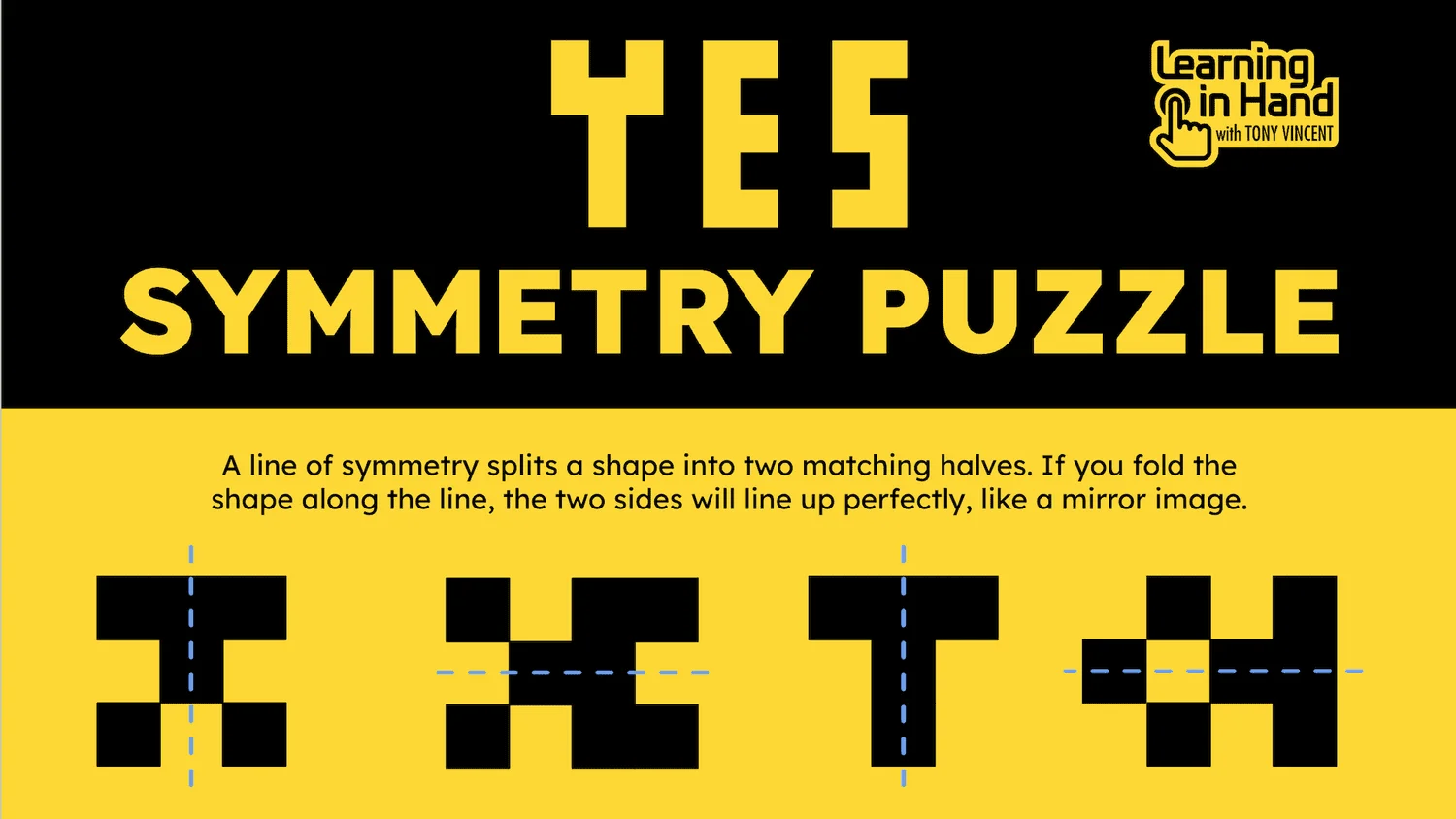
Challenge your students with the engaging YES Symmetry Puzzle, designed with the letters Y, E, and S. This hands-on activity not only tests their spatial reasoning but also fosters understanding of symmetry. For those interested, a 3D printer file is available for physical puzzle pieces, enabling a tangible learning experience.
The Role of Symmetry in Education
Symmetry plays an important role in various branches of mathematics and art. It's a concept that transcends disciplines, influencing everything from geometry to biology, where symmetrical patterns are the norm in nature. In the context of educational environments, employing puzzles like the YES Symmetry Puzzle offers more than just a challenge; it builds foundational skills that can be applied across subjects. Spatial reasoning, critical thinking, and problem-solving are all enhanced through such interactive learning methods. Engaging with puzzles encourages students to think outside the box and investigate various solutions, giving them a structured path to explore mathematical concepts.
Exploring the Puzzle Mechanics
Creating a symmetrical arrangement using Y and E is relatively straightforward due to their inherent lines of symmetry. However, the puzzle provides a great opportunity for students to explore how different configurations can still achieve symmetry. This aspect of the puzzle not only engages students but encourages them to comprehend symmetry in a hands-on manner. That’s where many traditional learning methods fall short. The YES Symmetry Puzzle asks students to observe and manipulate shapes, deepening their understanding of symmetry beyond textbook definitions.
The diverse shapes of the letters offer unique challenges. Y, for example, has a vertical axis of symmetry, while E presents horizontal configurations. Such differences allow students to explore the concept as they manipulate the physical or digital pieces. By experimenting with different arrangements, students begin to appreciate that multiple configurations can satisfy symmetrical criteria—where one solution isn’t necessarily prescriptive but rather a gateway to artistic creativity.
Technology Meets Education
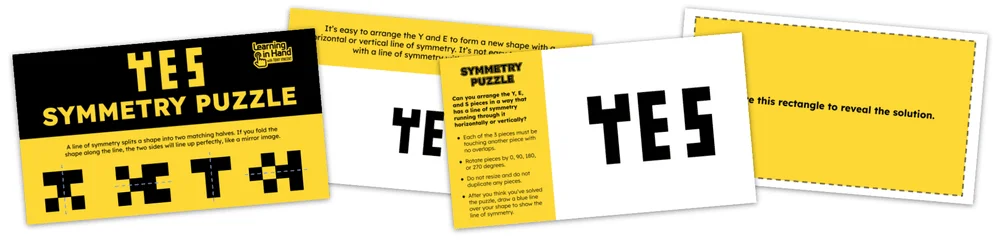
The digital version of the puzzle is accessible in Google Slides and PowerPoint. This integration of technology in the classroom environment can enrich the learning experience. Digital tools can enhance the way we approach traditional problems, allowing for more interactive and dynamic learning experiences. The first two slides introduce the challenge, while Slide 3 features movable pieces for arranging—something you may not find in standard worksheets. The interactive nature of these slides fosters engagement, allowing students to physically manipulate the pieces on-screen, increasing their investment in the learning process.
Instructions for Solving the Puzzle
Instructions for Solving the Puzzle:
Arrange the Y, E, and S pieces so that either a horizontal or vertical line of symmetry exists.
All pieces must touch another piece without overlapping.
Pieces can be rotated in increments of 0, 90, 180, or 270 degrees.
Do not resize or duplicate any pieces.
Once completed, draw a blue line to indicate the line of symmetry.
These instructions are straightforward, but they offer room for pedagogical creativity. Educators can modify these rules to make the activity more challenging based on student proficiency. If you think your students have a solid grasp of basic symmetry, consider introducing a timed component or requiring the use of all three letters in complex configurations. Such variations can keep the activity fresh and engaging as students work through the different levels of challenge.
Maintaining the Element of Surprise
The solution is available on Slide 4, hidden under a covering rectangle. Educators may wish to remove this slide before sharing the file to maintain the element of surprise during the class reveal. This suspense can energize the classroom when students finally uncover the completed puzzle, reinforcing both the joy of discovery and the excitement around solving challenges. It’s these moments that can ignite a passion for learning, drawing students deeper into the concepts at hand.
Implications and Future Outlook
The YES Symmetry Puzzle may appear to be a simple educational tool, but its implications extend far beyond mere entertainment in a classroom setting. As education increasingly moves toward hands-on, experiential learning activities, puzzles like this align perfectly with modern pedagogical approaches. This method mirrors a shift toward STEM-based education, where spatial reasoning and critical thinking are becoming essential skills in both the workforce and everyday problem-solving.
As technology continues to evolve, we may see more puzzles and educational tools leveraging augmented reality (AR) or virtual reality (VR) to teach complex concepts in even more engaging ways. What this means for you is that integrating traditional skills like symmetry with modern technology could pave the way for a more interactive educational experience. The demand for resources that promote both collaboration and creativity in classrooms is on the rise, and teaching tools that blend physical and digital learning are likely to be at the forefront of future educational innovations.
Access YES Puzzle in Google Slides Download YES Puzzle in PowerPoint

Discussion
Sign in to join the discussion.