This op-ed from Georgetown, Texas mother Courtney Parker Lopez offers what the school choice debate almost never surfaces: a ground-level, human account of why one family left public school, how they ...
By Courtney Parker Lopez, Mother
Over the past month, as students across Texas headed back to school, more than 85,000 families began a school year unlike any before it by using the state’s new education savings account program for the first time. Their choices have already become part of a familiar debate over school choice — who benefits, who loses, and what it means for public schools.
I’m one of those families. Here is what the numbers don’t show.
Homeschooling my middle daughter was never part of the plan. It was born out of necessity — out of watching a bright, curious child slowly lose her joy and confidence to a school system that couldn’t bend to fit her.
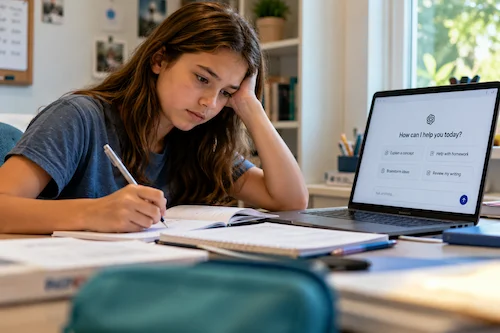
My oldest daughter thrives in public school. She has wonderful teachers, and I’m grateful every day for what that setting has given her. But my middle daughter’s brain works differently. Dyslexia and dysgraphia meant the very worksheets designed to help her became a source of daily anxiety. Several years ago, I watched her stop trying, not just academically but as a kid who used to laugh and take risks. When she begged to stay home one too many times, I knew we needed a different path, even though I had no idea what it would look like. Walking your crying child into school day after day forces a parent to make a change, whatever the uncertainties.
I pieced it together myself: a specialized curriculum built for kids who learn the way she does, occupational therapy support for her handwriting, all paid out of pocket because I had no other option. This year, Texas’s ESA program is covering much of those same costs, giving me the peace of mind that she can keep getting the education she needs for the long haul.
Getting here took some homework of its own. For families like mine, an IEP from a public school district can be an important part of accessing the program. Students with a recent IEP were among those given priority this year, which means that even though we left public school, I still work with our former district to keep my daughter’s current. Hers was entering its final year when the program launched, so this fall I found myself back on a Zoom call with the district we had left, renewing the same paperwork that documents why she needs a different kind of education in the first place.
Once we were approved, using the funds was much more straightforward. Purchases run through an online marketplace of approved providers, so there are clear guardrails
around where the money can go. But knowing what you can spend the money on is different from knowing what you should spend it on. That part has required knowing my daughter, paying attention to what works, and being willing to change course when something doesn’t.
We learned through trial and error. We tried a full-time online public school and then a self-paced program before finding the right fit with Outschool. There, she takes live online classes in small groups, with teachers we choose, in subjects that light her up, on a schedule that gives her more time where she needs it. Watching her in those classes has taught me more about how she learns than any progress report ever could.
Now I approach each semester with much more intention. Before she starts a new class, I message the teacher and explain what I know about her as a learner: she needs kindness and encouragement first, and stacks of worksheets simply don’t work for her. How a teacher responds tells me a lot about whether the class will be a good fit. Then I watch. Is she engaged? Is she gaining confidence? Is she actually learning? If something isn’t working, we change course. When it does work, those teachers become partners in her education. Her Spanish teacher, for example, built a one-on-one course around exactly where she is, rather than asking her to fit into a predetermined pace or curriculum.
Still, the best judge of whether a class is working isn’t me or the teacher. It’s my daughter, so I ask her. Her voice has become one of the most important measures of whether something is working.
She has a special interest in space science, and after a recent trip to NASA, she became fascinated by the potential for life on other planets. I signed her up for Chemistry for Kids as a trial, and she bounced out of her seat after the first class to shout, “Best class ever!”
She also loves understanding how machines work in depth, but she has never had the patience for Legos, so I found an engineering class called “How Machines Work.” She looks forward to it every Thursday, and she lights up when she tells me about it.
We have also found a math tutor who truly gets her. They’ve formed a bond I love to watch, and my daughter is more willing to take on challenging material under this teacher’s guidance. It took us years to find this combination, and I know many parents are still searching for theirs.
Our family is not as unusual as the loudest voices in the school choice debate suggest. Researchers at Johns Hopkins University found that homeschooling grew about 5 percent nationally last school year, nearly triple the pre-pandemic growth rate, with a third of reporting states hitting record numbers. An estimated 3.4 million American children now learn at home. Many of them, like my daughter, have learning differences their local schools struggled to serve.
I understand the worries about Texas’ new education savings account program, and I share some of them. My oldest daughter’s public school matters deeply to our family, and I want it funded and thriving. My third is in diapers now, and I can’t wait for her to join our neighborhood public school in a few short years.
But the debate over ESAs too often treats families like mine as an abstraction, a line item in someone else’s budget fight. For us, this program is not ideology. It is occupational therapy, a curriculum that works, and a child who laughs at the kitchen table again.
Texas will spend years arguing over what this billion dollars bought. But I already know what it bought my family: a daughter who believes she is smart again. That is worth protecting.
Courtney Parker Lopez is a writer and mother of three in Georgetown, Texas.
The post The School Choice Debate Looks Different From My Kitchen Table appeared first on Getting Smart.
Discussion
Sign in to join the discussion.