The lesson goes well. The student follows the explanation, works through problems with the teacher, asks a good question or two, and leaves feeling like the material finally makes sense. Three days la...
The lesson goes well. The student follows the explanation, works through problems with the teacher, asks a good question or two, and leaves feeling like the material finally makes sense. Three days later, facing a similar problem alone, they’re stuck again.
Most parents and teachers have seen this happen. The instinct is to question the lesson. Maybe it moved too fast, maybe the teacher wasn’t the right fit. Often neither is true.
The gap isn’t between a good lesson and a bad one. It’s between understanding something while someone guides you, and being able to use it on your own.
Understanding isn’t the same as learning
During a lesson, a student is supported by the teacher in ways that are easy to overlook. The teacher offers a hint at the right moment, catches an error before it compounds, asks a question that redirects attention, and adjusts the pace when something isn’t landing. That scaffolding makes the material feel clear.
But the moment the lesson ends, all of it disappears. What’s left is whatever the student can retrieve and apply without help. Pulling something out of memory builds far more durable knowledge than reviewing it does, even though reviewing feels more productive while you’re doing it. Recognition is not the same as recall.
A great lesson can create understanding. Lasting learning depends on what happens afterward.
The between-lessons gap
A student might spend one or two hours a week with a teacher. What happens in the six days between lessons may matter just as much as what happens during the lesson itself. That gap is where new knowledge is either reinforced through retrieval and practice, or begins to fade. Research on the forgetting curve shows just how quickly newly learned information can be lost without reinforcement.
Call it the between-lessons gap. It’s the stretch of time after one session ends and before the next begins, when no one is watching and nothing is structured.
Education systems and learning technologies have invested enormously in improving the lesson itself: better pedagogy, better platforms, better teacher training. Far less attention has gone to the question of what happens in between.
Students forget. They get stuck and stop. They put off practice until the night before the next session, or skip it entirely. And they arrive at the following lesson with the teacher having no idea what happened in the meantime.
More practice isn’t necessarily the answer
The obvious conclusion is that students simply need more homework. That conclusion is wrong, or at least incomplete.
Practice matters enormously, but practice without feedback can reinforce the wrong things. A student can rehearse the same misconception twenty times and leave with it more firmly embedded than before. They can hit the same wall repeatedly and conclude they’re simply bad at the subject. Or, most commonly, they can drift toward the problems they already know how to solve, because those feel productive.
Feedback is one of the strongest levers in education but only certain kinds, and only at the right moment. The variable that predicts whether practice works isn’t volume. It’s whether the student finds out quickly when they’re wrong, and whether what comes next adapts to that. Spreading practice out over time rather than cramming it compounds the effect. Practice, timely feedback, and adjustment have to travel together.
Technology can help, without replacing the teacher
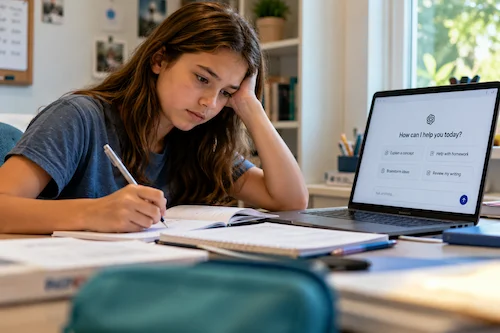
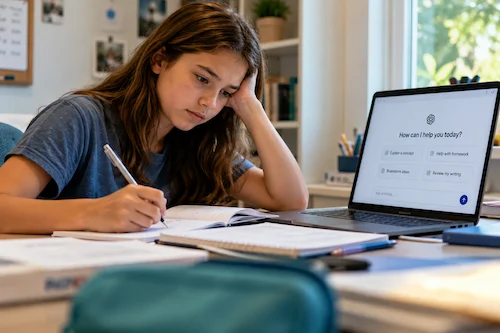
This is where AI becomes genuinely useful – not as a replacement for a teacher, but as a presence during the hours when no teacher can realistically be there.
Generate practice at the right level of difficulty. Tell the student immediately whether an answer is right, and why. Notice when the same error keeps recurring and surface it rather than letting it repeat. Identify which areas are weak and route more practice toward them.
There’s a second effect that matters more, and gets discussed less. The information flows back to the teacher. Instead of opening each session by reconstructing what happened over the past week, what was attempted, what went wrong, where the student gave up, the teacher arrives already knowing. That changes what the hour is spent on. Diagnosis takes less of it, and teaching takes more.
None of this solves every problem between lessons. Students still need motivation, encouragement, and accountability. Those are deeply human parts of learning, and another reason technology works best when it supports a teacher rather than tries to replace one.
Used this way, AI makes human time more valuable by giving the teacher a clearer picture of what happened between sessions and where their attention is needed most.
The lesson should be part of a learning loop
The useful reframe is to stop treating each lesson as a self-contained event and start treating it as one step in a loop:
Lesson → Practice → Feedback → Identified gaps → Next lesson
Each stage feeds the one after it. Practice reveals where understanding is thin. Feedback corrects it before it hardens. The gaps that remain shape what the next session addresses. The teacher still directs the whole arc, but the arc no longer pauses for six days between sessions.
We spend a great deal of time asking how to make lessons better. Perhaps we should spend as much time asking what happens once they’re over.
The lesson may end after an hour. Learning shouldn’t.

Discussion
Sign in to join the discussion.