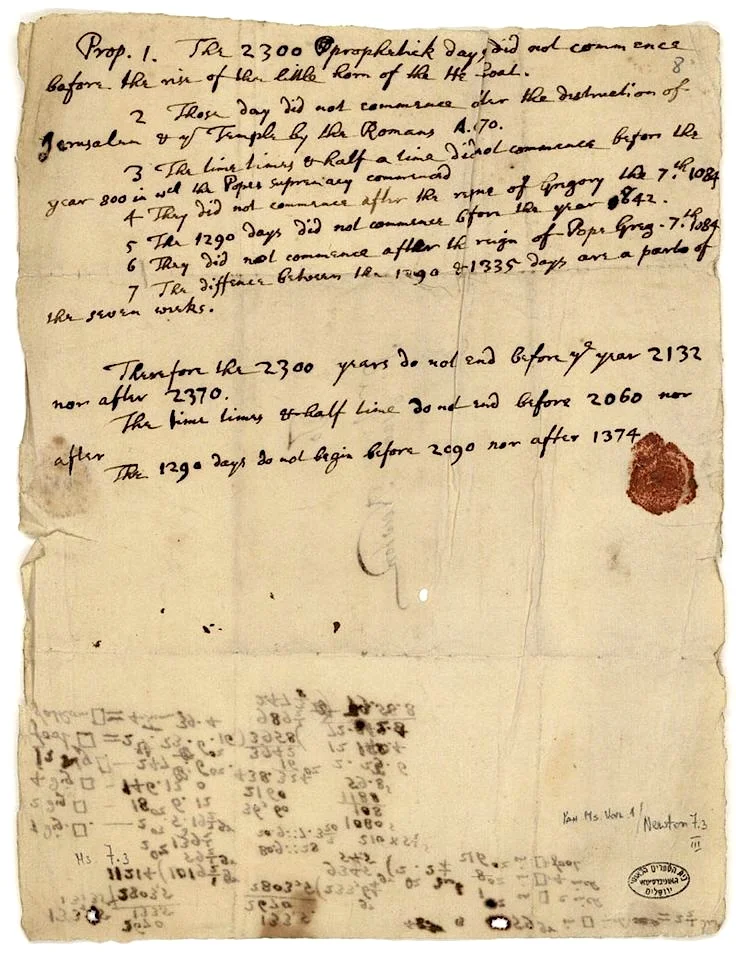
Isaac Newton predicted the world would end in 2060 based on meticulous calculations tied to biblical prophecy, merging science and theology in an unusual way.
Newton's Unconventional Beliefs
Throughout history, doomsday predictions have captivated audiences, from scientists warning of environmental catastrophes to religious figures proclaiming apocalyptic events. In the 1700s, one of the most notable figures diverged from standard scientific thought—Sir Isaac Newton. Known primarily for his groundbreaking contributions to physics and mathematics, Newton also harbored prophetic ambitions, believing the world would reach its end in 2060. This sort of intertwining of science and prophecy might seem unusual today, but it highlights a complex engagement with knowledge that has characterized human thought for centuries.
Integrating Science with Prophecy
Newton epitomized the fusion of science and mysticism during the Scientific Revolution. While he laid the foundations of classical mechanics and formulated the laws of motion, he also explored alchemy, that mystical tradition of transforming base metals into gold. His pursuit of the fabled Philosopher's Stone wasn't merely a bizarre hobby; it represented a broader quest for ultimate knowledge that many at the time believed could lead not just to riches, but to enlightenment. Beyond these pursuits, his theological interests drove him to interpret biblical scriptures, particularly the Book of Daniel, where he pinpointed the year 2060 as a potential end date. This intersection paints a picture of a man driven by an insatiable curiosity that spanned scientific inquiry and the spiritual realm.
The 2060 Calculation
In a 1704 letter preserved at Jerusalem's Hebrew University, Newton outlined his "reconing" method for arriving at this date. He stated, “So then the time times & half a time are 42 months or 1260 days or three years & a half…” From this numerical framework, Newton traced back to historical events, such as the conquest of three kingdoms around 800 AD, positing that 2060 would mark the culmination of these prophetic timelines. Newton expressed certainty about his calculations, dismissing the “rash conjectures of fancifull men” that pervaded his time. These assertions reveal a man of great conviction, yet they also remind us that even the most brilliant minds can be led astray by their beliefs.
Insights from Historical Context
Newton's prediction wasn’t just a whimsical thought; it reflected a broader context of the Enlightenment, where scientific inquiry often coexisted with esoteric beliefs. A historian of science, Stephen Snobelen, pointed out that Newton's dual interests have drawn attention from both scholars and spiritual seekers alike. His work illustrates how the boundaries between science, superstition, and religion were not always clear-cut during his era. This fascination with mystical interpretations of the universe wasn't unique to Newton; it was a characteristic of a time when the very fabric of understanding was still being woven together. If you're working in this space, you'll find that many intellectuals grappled with similar tensions, attempting to reconcile knowledge with belief.
Understanding Newton's Prophetic Philosophy
Importantly, Newton's view of the apocalypse diverged from the conventional idea of a cataclysmic end. Instead, he envisioned a time when Christ would return, ushering in a millennium of peace alongside the fulfillment of biblical prophecy. This perspective resonates with the themes emerging in various contemporary evangelical circles, where the emphasis is more on renewal than destruction. It's interesting to see how Newton's beliefs echo modern interpretations that advocate for hope rather than fear, suggesting an eternal struggle between pessimism and optimism. (And this is the part most people overlook.) Newton’s blend of prophecy and science offers a narrative of redemption rather than despair, challenging simplistic views of doomsday scenarios.
The Legacy of Newton's Predictions
While 20th-century physics introduced concepts that challenge Newton’s assumptions about a stable universe, his foundational theories remain integral to modern scientific understanding. Scholars argue that despite the inaccuracies in his prophetic calculations, Newton's work laid the groundwork for future explorations of physical laws. Nonetheless, equating his prophetic methods with contemporary doomsday theories reveals the irrationalities shared across epochs, from the Millerites to modern-day predictions. His 2060 projection could be seen as a cautionary tale illustrating how authority in science doesn’t exempt one from errant beliefs. This complexity adds layers to Newton's legacy; it’s not just about the laws of motion but also how human concerns about destiny can intertwine with scientific achievement.
A Critical Examination
As fascinating as Newton’s beliefs may be, his approach to prophecy shouldn't be given undue weight compared to other famed doomsday predictions throughout history. His combination of rigorous scientific thought with biblical numerology presents an enduring curiosity but serves as a reminder of the varied pathways through which people seek to understand existence and fate. While we can appreciate his diligence in this area, it’s vital to approach his apocalyptic outlook with a critical lens. It's easy to see him as a genius lost in his own theories, but perhaps he was simply a man seeking answers in a world full of uncertainty.
Future Implications: The Intersection of Science and Belief
Looking ahead, the implications of Newton’s doomsday predictions resonate beyond the 21st century. As humanity grapples with existential threats like climate change or artificial intelligence, the way we integrate scientific understanding with belief systems will become increasingly relevant. There’s a delicate balance to maintain. If we’re not careful, the urge to forecast great upheavals can overshadow constructive discussions about renewal and sustainable futures. Newton's mixture of science and prophecy serves as a lens through which we can examine our own convictions and fears, illustrating how history might repeat itself in the debates that lie ahead.
In the grand scope of human knowledge, Newton's doomsday projections might seem peculiar against the backdrop of his monumental contributions to science. The year 2060 serves as a fascinating detail in the life of a man whose work transcended not just science, but also the realms of faith and prophecy. Such intersections are not merely historical curiosities; they challenge us to reflect on how we engage with uncertainty and the narratives we form as we look to the future.

Discussion
Sign in to join the discussion.