Project-based learning fosters authentic curiosity and engagement, leading to deeper understanding and long-lasting skills for students beyond the classroom.
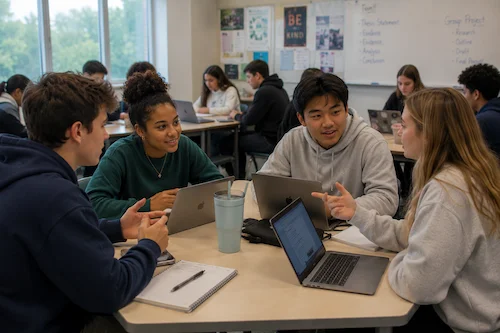
For many students, traditional schooling often feels transactional: do the work, earn the marks, and move on. However, this framework limits what students can truly express about their knowledge and abilities. When reconnecting with former students, it’s clear they rarely remember specific tests or assignments. Instead, they talk about hands-on experiences, collaborative problem-solving, and engaging in thought-provoking inquiries. This phenomenon highlights the essence of project-based learning (PBL).
Engaging Students with Real-World Issues
In the 2015-2016 academic year, amid a politically charged conversation about immigration, I taught in San Antonio, where the U.S.-Mexico border serves as both a geographical and emotional crossroads. My students, influenced by their proximity to the border and personal connections, posed a compelling question: “What is actually happening there, and what does a border really mean?”
This led us to develop a project-based course anchored around a central inquiry: What is the purpose of a border, and how has your view evolved? Over several months, we immersed ourselves in this question. The students traveled to the border, engaged with the physical landscape, and conducted interviews with key stakeholders, including Border Patrol agents and asylum seekers.
Through this project, they not only gained insights into the complexities of the issue but also understood how varied life experiences shape perspectives. Regularly revisiting our central question allowed them to reflect on their evolving thoughts, creating a lasting impact that conventional classroom instruction seldom achieves.
Beyond Traditional Assessment
Reconstructing learning around authentic projects broadens the definition of what it means to succeed in school. Traditional assessments often provide only a narrow snapshot of students’ capabilities, limiting their potential. During our border course, a local organization sought our help to support recently released asylum seekers. My students took on logistical roles, managing transportation and caring for children.
What struck me was witnessing a previously quiet student flourish. In this context, he was organizing schedules and communicating across language barriers, showcasing leadership and problem-solving skills that a conventional classroom could never reveal. Another student, hesitant to engage in discussions, found empowerment through interviewing diverse adults. Understanding that knowledge is multifaceted freed him from the notion of a single right answer.
This transformation stemmed from more than just the format of learning; it was the meaningful purpose behind it. PBL honors students’ curiosity, identities, and practical abilities, redefining success in education.
The Lasting Benefits of Project-Based Learning
As my former students transitioned to college, two observations emerged: they noted their peers' hesitance to ask questions and their confusion about why students spent time outside of class engaged in high school projects. High-quality project-based learning significantly reshapes how knowledge is retained in students:
- Intrinsic motivation over grades: When driven by authentic interest, students pursue understanding rather than merely chasing grades.
- No ceilings on learning: Rigid educational frameworks often impose limits; genuine projects allow students to exceed initial expectations.
- Confidence through presentation: Regularly showcasing their work to real audiences fosters communication skills and confidence that are critical for future success.
Institutional Support for Project-Based Learning
Building a culture that emphasizes project-based learning involves district-wide commitment and support. Teachers working alone cannot institute the necessary changes. District leaders must create environments conducive to long-term retention and successful project execution:
- Define without uniformity: Establish district-wide standards for essential skills, while allowing educators the flexibility to adapt projects to their local communities.
- Broaden success metrics: Move beyond traditional testing by incorporating public exhibitions and student presentations that truly demonstrate learning.
- Invest in ongoing coaching: Transitioning from traditional instruction to project-based teaching demands real practice and collaboration among educators.
Creating Engaging, Lasting Learning Experiences
Reflect on a moment when you felt deeply engaged in learning—what sparked that genuine interest? Project-based learning is specifically designed to replicate those conditions for every student. In a landscape increasingly dominated by rapid information access via AI, the educational focus must shift toward nurturing curiosity, empathy, and the ability to tackle complex issues. Crafting learning experiences that are interconnected and joyful allows students to retain far more than mere facts. It is these engaged learners who will thrive in the future of education, the workplace, and society. PBL stands out as a powerful strategy for fostering such capabilities.

Discussion
Sign in to join the discussion.