Balancing teacher autonomy with coherent practices is vital for educational success, as evidenced by the latest TALIS data and diverse international approaches.
By Andreas Schleicher, OECD Director for Education and Skills
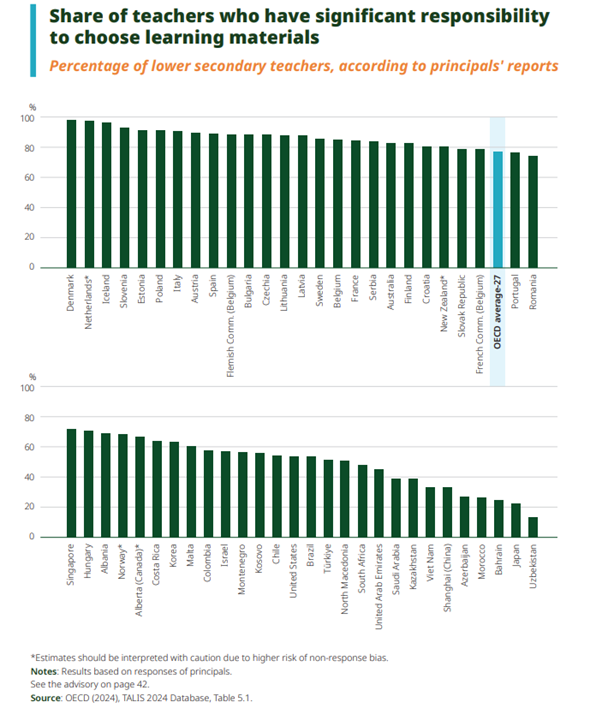
Education systems consistently face the challenge of balancing meaningful teacher autonomy with the need for coherence in classroom practices. Insights from the Teaching and Learning International Survey (TALIS) reveal significant variability in how much freedom teachers have across different nations. In countries like Azerbaijan and Japan, fewer than 30% of lower secondary teachers have the latitude to select their teaching materials. In contrast, nations such as Denmark and Slovenia report over 90% of teachers enjoying this responsibility. This raises a pressing question: how much freedom should educators really have in their classrooms?
At first glance, many might assert that teachers need the freedom to engage students rather than adhering strictly to top-down directives. Yet, various pedagogical and systemic factors deserve consideration. TALIS findings indicate that teachers experiencing higher autonomy in lesson planning and delivery often display greater confidence in managing classrooms. Furthermore, increased autonomy correlates with enhanced job satisfaction, reduced stress, and a heightened ability to adjust lessons according to student needs.
However, correlation does not imply causation. While the data suggests that autonomy benefits teaching quality, it’s possible that confidence and competence, especially among more seasoned teachers, foster this autonomy instead. Experienced educators—those with ten or more years in the classroom—tend to thrive when given the freedom to mold their teaching styles. On the flip side, excessive autonomy for novice teachers may be counterproductive due to their lack of established support networks.
So, what should policymakers do? While advocating for teacher autonomy is important, it shouldn’t lead to a fragmented educational framework. Innovative or untested methods risk undermining academic outcomes and eroding public trust in educators. Thus, establishing a shared professional culture that prioritizes evidence-based practices is essential. This approach ensures consistency in students’ learning experiences across classrooms and over time.
It's critical for education systems to evaluate which educators receive more leniency in their teaching approaches and the contexts in which it should be granted. Teacher characteristics—such as experience and competence—should guide autonomy decisions. For instance, emerging teachers may require structure before they can be expected to exercise freedom. Meanwhile, even seasoned instructors benefit when their autonomy is complemented by a collaborative school culture. Such communities enable them to develop collective standards and align teaching methodologies throughout the system.
Different countries have responded to these challenges with varied strategies. Take Slovenia, for instance: their decade-long reform in upper secondary education has empowered teachers with more responsibility in planning and execution. This has culminated in significant classroom autonomy, aligned with accountability achieved through common goals and resources that guide educators. Such reforms not only foster collaboration among teachers but also safeguard against potential gaps in coherence that rising autonomy might create.
Colombia also exemplifies a successful model by encouraging teacher engagement in educational governance, thus allowing their voices in curriculum and policy matters. The country has instituted five annual weeks dedicated to professional development, where teachers can refine their practices and work on school planning collaboratively. These initiatives exemplify how structured freedom can coexist with shared accountability, paving the way for peer learning and alignment with educational objectives.
However, offering autonomy without sufficient oversight can be detrimental. In Italy and Norway, substantial instructional freedom reported by many teachers is offset by a lack of appraisals; in some instances, up to 25% of teachers have never undergone assessment. In Finland, that figure exceeds one-third. As a result, education leaders may lack insight into classroom activities, risking educational quality.
The implications of inadequate oversight are profound. Effective accountability systems should allow for innovation while also providing clear benchmarks for evaluation. More critically, they should nurture professional communities where educators engage in peer observations, share feedback, and come to collective understandings of effective practices. This ethos of collaboration is what empowers professional autonomy while ensuring a coherent educational impact.
That said, it's essential to ensure that accountability mechanisms don’t swing too far in the punitive direction. Systems that are overly rigid or disconnected from real classroom dynamics can stifle creativity and diminish teaching quality. The overall objective should be to support autonomy, embedding it within a strong professional culture that encourages collective goals rather than fostering isolated practices.
This post is part of a series focused on findings from the OECD’s Teaching and Learning International Survey (TALIS) 2024: The State of Teaching. TALIS, the largest survey of teachers and school leaders globally, sampled around 280,000 lower secondary educators across 55 educational systems. For further details, visit the TALIS support materials.


Discussion
Sign in to join the discussion.