The divide between public and private early childhood education settings risks perpetuating inequality. Focused investment and oversight are essential for equity.
By Andreas Schleicher, OECD Director for Education and Skills
Early childhood education and care (ECEC) is often viewed as a fundamental building block for equal opportunity among children. However, the reality sees persistent inequalities despite increasing participation rates across OECD nations. The disparity in resource allocation and accessibility significantly impacts vulnerable populations, raising essential questions about the effectiveness of current ECEC structures.
Public vs. Private Provision
In many OECD countries, the ECEC landscape is divided between publicly operated and private institutions, which include both non-profit and for-profit entities. The distribution of these settings varies widely. For instance, public management dominates pre-primary ECEC in nations like Chile, Denmark, and Sweden, where over 60% of these facilities are public. Conversely, private operators lead in Germany, and in countries like Ireland and New Zealand, all ECEC establishments are privately managed, with many operating for profit.
Marketization and Inequity
The trend toward privatization highlights governments' reliance on private providers to enhance service availability, but it raises equity concerns. In certain regions, public facilities are more prevalent in rural and socioeconomically disadvantaged areas, while private centers are often concentrated in wealthier urban locales. This segregation greatly impacts the quality of education and care provided to children from different backgrounds.
The Impact on Vulnerable Populations
Disadvantaged children, including those from low-income families and minority backgrounds, benefit most from quality ECEC. Ironically, these children often find themselves in provision with fewer resources and lower quality standards, perpetuating existing social divides from an early age. According to TALIS Starting Strong data, public ECEC centers frequently report lesser physical conditions compared to their private counterparts. In some cases, private settings excel in involving families, a key factor for positive child outcomes.
Case Studies: Divergence in Quality
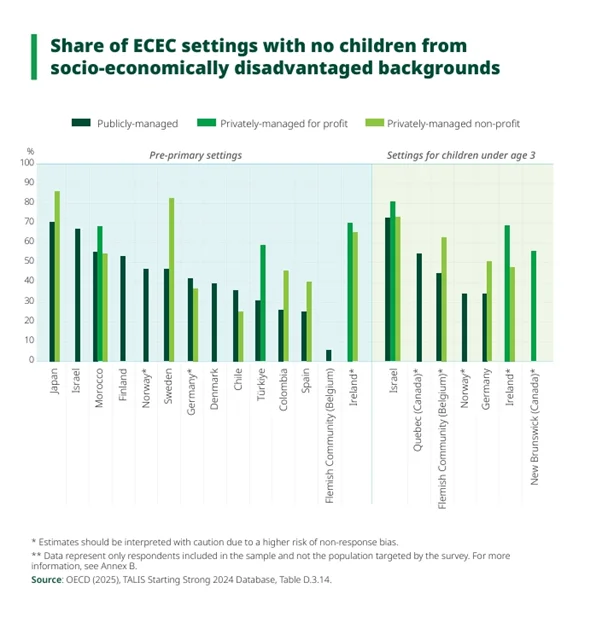
The contrast between public and private ECEC is stark in various countries. For example, in Türkiye, 59% of private settings serve no children from socioeconomically disadvantaged families, a stark contrast to 31% in the public sector. Similarly, Morocco's figures show that 68% of private providers do not cater to disadvantaged children, as opposed to 55% for public ones. Moreover, privately run centers tend to offer superior physical spaces than public facilities, shaping experiences for millions of children.
Exceptions in Distribution
Notably, there are exceptions to this trend. In the Flemish Community of Belgium, private and public settings mirror one another in both distribution and quality in certain ECEC levels. Moreover, in Germany and the Flemish community, the demographic of vulnerable children is quite similar across both types of providers.
Government Responsibilities
Governments are caught in a balancing act; while private provision can enhance availability and participation rates, without precise regulatory measures, it risks deepening existing inequalities. Public ECEC centers require sufficient funding to address the challenges they face with higher-needs populations.
Recommendations for Improvement
To address these issues, governments should prioritize investments in public ECEC settings to better support the varying needs of diverse populations, especially vulnerable groups. Allocating additional personnel, training, and resources to centers serving high proportions of disadvantaged children can significantly improve outcomes.
Simultaneously, private providers—many of which receive public funding—warrant close scrutiny. In certain regions, privatized settings already undergo frequent external evaluations and inspections, particularly regarding fiscal operations. Countries like Türkiye, Spain, and Finland have instituted stricter regulatory measures concerning structural quality in ECEC.
Ensuring Quality and Equity
Funding should be contingent upon meeting strict quality benchmarks and transparency standards to prevent misuse of public resources. Inclusion incentives, such as subsidies for private ECEC settings serving disadvantaged children or conditions tied to operating in underprivileged areas, are additional strategies to foster equity.
Implementing these measures could curtail the risk of entrenched inequality in mixed ECEC markets involving both public and private providers. High-quality ECEC represents an economical strategy to lessen future expenditures on remedial education and social services. However, realizing this potential necessitates effective governance and strategic investments to ensure that the promise of equal opportunity doesn’t remain unfulfilled.
This blog is based on a chapter from the TALIS Starting Strong 2024 Insights and Interpretations brochure: talis3s2024-insights-interpretations.pdf.
The Starting Strong Teaching and Learning International Survey (TALIS Starting Strong) assesses issues affecting early childhood education and care (ECEC). In 2024, it surveyed the ECEC workforce for children under 3 and in pre-primary settings, catering to ages 3-6, across 17 countries and subnational entities.



Discussion
Sign in to join the discussion.