Despite daily affirmations from children and parents, early childhood educators feel undervalued by society. This sentiment threatens the sector's sustainability.
By Andreas Schleicher, OECD Director for Education and Skills
In Early Childhood Education and Care (ECEC) settings worldwide, educators are often welcomed by joyous interactions—hugs, smiles, and laughter from the children and appreciation from parents. Yet, a significant disparity exists in how educators perceive their societal value. This perceived lack of recognition poses a real risk to the sector's future.
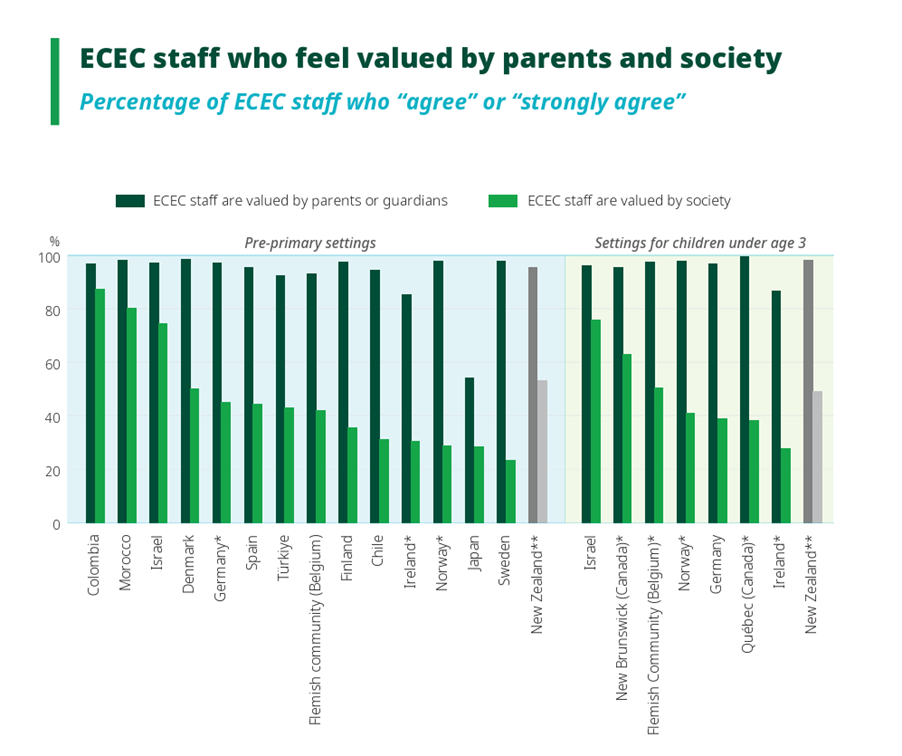
Data from the OECD’s TALIS Starting Strong report reveals that over 80% of ECEC staff across various countries report feeling valued by parents or guardians. In stark contrast, when asked about societal recognition, the figures drop considerably. While some countries like Colombia and Morocco show strong societal appreciation—where over 70% of staff feel valued—this doesn’t hold true in countries like Chile, Japan, and Sweden, where fewer than one in three educators feel respected by the broader community.
The gap between personal interactions and societal recognition is striking. ECEC staff often thrive on the daily connections formed with families and children, which tend to foster a more fulfilling work experience. Outside the confines of ECEC settings, however, these sentiments deteriorate. Societal perceptions frequently categorize ECEC staff as mere caregivers, rather than skilled professionals. Inadequate pay and minimal public visibility further exacerbate feelings of undervaluation.
Interestingly, despite the lower societal acknowledgment, ECEC staff often report feeling more valued than their counterparts in secondary education. In places like Belgium and Türkiye, ECEC professionals express twice the sentiment of being valued compared to high school teachers.
The implications of this undervaluation are troubling. A lack of recognition can hinder the recruitment and retention of skilled professionals. Many educators are dissatisfied with both their compensation and the societal prestige of their roles. This discontent can contribute to staffing shortages, high turnover rates, and diminished morale—factors detrimental to the quality of education and care provided to children.
The workforce's chronic underappreciation perpetuates the misleading belief that working with young children lacks skill, despite its critical role in child development. Notably, educators who feel less valued tend to have extensive experience and higher qualifications. Hence, the sector risks losing talented individuals who might otherwise innovate or pursue further training.
Staff shortages are cited by ECEC leaders as a leading cause of diminished educational quality. In several regions, the challenge is particularly acute. In countries like Germany and Norway, more than half of ECEC centers report struggles to maintain quality services due to staffing inadequacies.
Traditionally, increasing funding for the sector has been brought up as a solution. However, raising salaries in the context of tight budgets is a complex challenge. Although there’s widespread acknowledgment of early years' significance in shaping lifelong outcomes, investment in the ECEC workforce has not kept pace with this understanding.
To remedy these issues, policymakers must strategically elevate pay and the professional standing of ECEC workers. One promising approach would be the creation of a diversified career framework within the sector. By defining a broader spectrum of roles—such as lead educators and family engagement coordinators—governments can design clear pathways for professional advancement, with corresponding increases in pay and responsibilities that reflect the complexity and impact of their work.
This tiered system can drive ongoing professional development and elevate both the status and standards of the sector. Countries like Colombia, Belgium, and Spain demonstrate that by achieving these aims in pre-primary education, staff are less inclined to leave the profession altogether, instead aspiring to roles with greater responsibility. These same regions often report higher levels of societal appreciation and job satisfaction among their ECEC staff.
The gender imbalance in the workforce compounds the issue, with maternity leave and family caregiving contributing to more frequent absences compared to other sectors. Solutions could include establishing pools of qualified replacement educators to mitigate the impact of these absences. Moreover, efforts to recruit more men into the profession could help balance the gender representation.
Public campaigns and policy narratives should aim to reinforce the importance of ECEC professionals in society. Furthermore, designing more flexible parental leave options for both mothers and fathers can support a more equitable distribution of caregiving responsibilities. Collectively, these strategies could cultivate a more resilient and valued ECEC workforce.
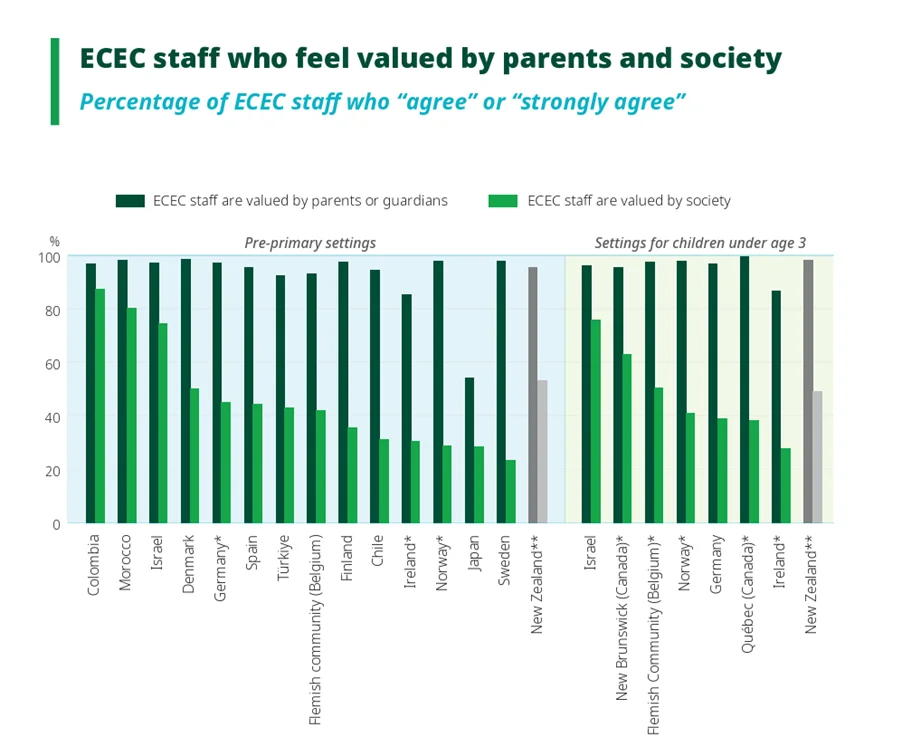
* Estimates should be interpreted with caution due to a higher risk of non-response bias. New Brunswick (Canada)* Flemish Community (Belgium)* Norway* Germany Québec (Canada)* Ireland* ** Data only represent respondents included in the sample and not the population targeted by the survey. For more information, see Annex B. Source: OECD (2025), TALIS Starting Strong 2024 Database, Table D.8.2.
This blog is based on a chapter from the TALIS Starting Strong 2024 Insights and Interpretations brochure: talis3s2024-insights-interpretations.pdf.
The Starting Strong Teaching and Learning International Survey (TALIS Starting Strong) evaluates issues impacting early childhood education and care (ECEC). In 2024, the survey involved ECEC professionals in under-3 and pre-primary settings, which typically cater to children ages 3-6, across 17 countries and subnational entities.



Discussion
Sign in to join the discussion.