PISA results show stagnation in educational achievement globally, with growing inequalities and declines in reading, math, and science performance.
Unveiling PISA 2025 Findings
The latest results from the Programme for International Student Assessment (PISA) highlight concerning trends in global education. As technological advancements and social complexities accelerate, many expect educational outcomes to rise; however, PISA data reveal a more troubling reality. While some countries show gains, many others languish, with stagnation or declines in key areas.
Stability Meets Decline
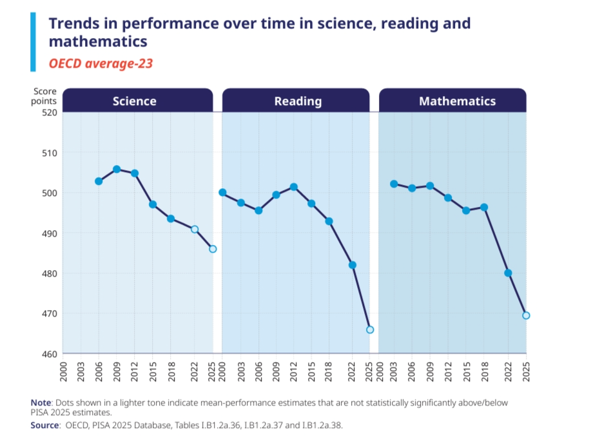
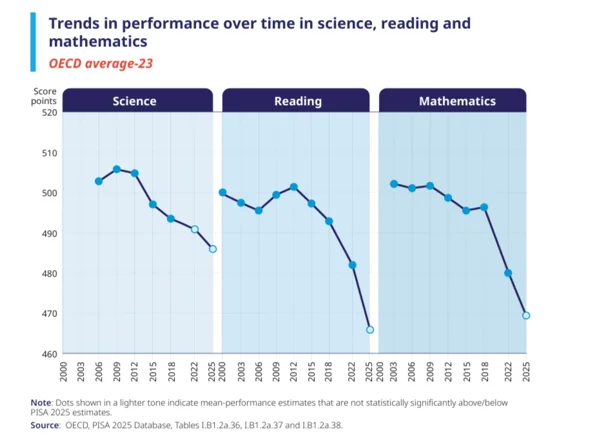
PISA’s latest assessment zeroes in on science, where OECD countries averaged a notable 7-point decline between 2015 and 2025. Mathematics has taken a more pronounced hit, falling 22 points across OECD nations compared to an 8-point drop in other systems. Reading performance has suffered the most, with OECD students scoring 28 points lower than a decade prior. Such shifts underscore the importance of context in analyzing these outcomes, as each 20-point change roughly equates to a year of educational progress.
The Challenge of Low Performance
About 29% of 15-year-olds in OECD countries now rank as low performers across science, mathematics, and reading—up from 25% just a year earlier. This group struggles with fundamental tasks like interpreting simple data or deciphering basic texts. The implications are staggering; as today's society increasingly relies on literacy and numeracy, a significant portion of students cannot meet these essential demands.
Reading as a Critical Indicator
Alarmingly, reading assessments have revealed sharp declines in critical skills necessary for navigating an information-rich world. Students are finding it harder to critically evaluate sources and synthesize information, leading to a worrying rise in "hasty reading," where quick but incorrect answers are common. Various factors contribute to this shift, including digital distractions and a decline in motivation for reading—elements exacerbated by the aftereffects of the COVID-19 pandemic.
Inequalities on the Rise
The growing divide in educational performance among various demographics is another significant highlight of the PISA results. The gap between students at either end of the achievement spectrum is wider than ever, particularly in science, where OECD nations have witnessed an expansion of over 15 score points between the top and bottom performers since 2018. This trend indicates that education systems may be failing to elevate struggling students while simultaneously not fostering overall achievement.
Success Stories Amidst Challenges
Despite the overall decline, some countries have made noteworthy progress. Within the OECD framework, nations like Costa Rica, Slovakia, Türkiye, and the UK have demonstrated improvements in science scores. Similarly, countries outside the OECD, including Cambodia, Uruguay, and Uzbekistan, also recorded significant achievements. These instances reveal that dedicated efforts by students and educators can yield positive changes, worthy of recognition.
Top Performers and Consistency
When it comes to top performers, students from Chinese jurisdictions such as Beijing and Shanghai excelled in the PISA science assessment, scoring an impressive 597 on average—far surpassing the OECD average of 482. Singapore and Japan also ranked highly, demonstrating strong abilities to tackle scientific challenges. This correlation between high scores and strong performance in mathematics and reading further emphasizes the interconnectedness of these disciplines.
Examining Academic Segmentation
Another noteworthy trend is the differential performance between schools. A select few countries, such as Indonesia and Finland, have achieved minimal performance variation across schools, indicating a more equitable educational landscape. In contrast, several other nations experience stark disparities, where performance hinges greatly on institutional quality rather than individual capability. Such segregation contributes to larger systemic inequalities, exacerbating the challenges faced by lower-performing students.
Long-term Challenges to Educational Performance
So, what accounts for the decline in educational outcomes globally? While the fallout from pandemic-induced disruptions is significant, many argue that systemic issues were in play long before 2020. The PISA data point to deeper, more embedded issues, such as the impact of digital media on attention spans and overall attitudes toward education.
Looking Forward: Adapting to New Realities
Moving forward, policymakers face a mounting challenge not just to restore pre-pandemic educational standards but to ensure that education systems are equipped to adapt to evolving social, technological, and economic landscapes. The PISA findings serve as a crucial barometer for understanding where we stand and the path ahead for global education.
This analysis draws on insights from the PISA 2025 Insights and Interpretations brochure.



Discussion
Sign in to join the discussion.