Nursing education needs to prioritize clinical reasoning over rote memorization, guiding students through structured learning strategies for real-world application.
In nursing education, a recurring query from students revolves around the desire for more detailed study guides. On the surface, this may suggest a wish to anticipate exam content. However, it's clear from experience that many students are seeking guidance in cultivating their ability to traverse the extensive landscape of nursing knowledge.
Often, students arrive in nursing programs armed with study techniques focusing on fact retention. Yet, the reality of nursing demands far more: the ability to discern clinically pertinent cues, prioritize patient needs, draw knowledge into unfamiliar contexts, and articulate the reasoning behind clinical decisions. Hence, fostering clinical reasoning and judgment in students is becoming a key element in nursing curricula, underscored by recent research (Gonzalez et al. 2021; Camp-Spivey et al. 2024).
The Strategy
To assist students in transcending mere memorization and embracing critical clinical reasoning, I have integrated recognition-based clinical judgment worksheets into my courses.
These worksheets are designed to present short patient scenarios coupled with open-ended questions, prioritization tasks, and application challenges. Unlike traditional study guides that rely on recalled facts, these worksheets compel students to identify significant patient cues, rationalize their reasoning processes, and prioritize issues—all vital skills in clinical practice. Research corroborates that similar active learning methods promote the evolution of clinical judgment in nursing students (Watkins et al. 2025).
It's essential to clarify that these worksheets are not meant to supplant reading or lecture materials; rather, they offer structured opportunities for students to engage with content while honing their critical thinking skills.
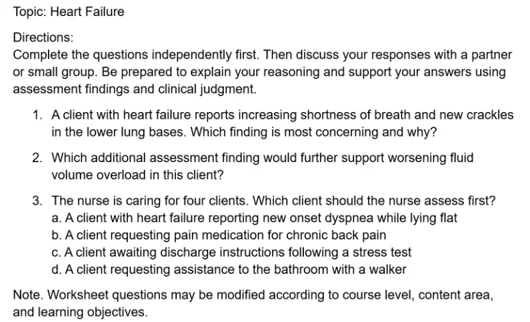
For reference, Figure 1 illustrates a sample worksheet which can be tailored to suit various curricula and learning objectives, promoting essential skills like cue recognition and prioritization through collaborative dialogue.
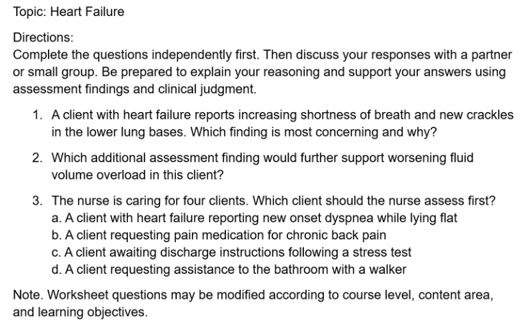
Figure 1. Sample Recognition-Based Clinical Judgment Worksheet
Implementation of Worksheets
Students start by filling out the worksheet independently, after which I employ a think-pair-share strategy. This allows them to compare their responses, discuss their rationale, and engage in broader class discussions on the scenario at hand.
Such conversations often reveal diverse approaches to the same patient scenario, providing rich opportunities to analyze clinical judgment, challenge biases, and explore various strategies in patient care.
Faculty-led discussions become an integral aspect of this activity. Instead of merely determining right or wrong answers, we delve into the reasoning processes that underpin clinical decisions. This shift encourages students to articulate their thought processes rather than focus solely on the final answer. Research (Wankier and Beynon 2025) emphasizes the significance of applying knowledge through clinical reasoning as essential to developing clinical judgment.
An unexpected advantage of this instructional method is the elevated quality of class discussions that emerge. Students often reach different conclusions from identical scenarios, enriching the classroom dynamic as they learn from faculty insights and their peers' perspectives.
Why This Works
This approach effectively shifts students’ mindsets from rote memorization to active application of knowledge. Instead of fixating on exam content, students start to inquire about patient situations and the rationale for their actions.
It also plays a vital role in building student confidence. Through formative discussions, it's evident that many students can arrive at the correct answer but struggle to articulate their reasoning. Others may hesitate to engage due to uncertainty regarding their responses.
Engaging repeatedly in structured reasoning tasks not only develops students’ ability to express their clinical thought processes but also bolsters their confidence in their clinical judgment. This confidence isn't overconfidence; it's about fostering a readiness to engage, contribute, ask questions, and explain their thought processes. The ability to justify an intervention, recognize a complication, or prioritize patient needs signals substantial growth in their clinical acumen.
Adapting the Approach for Faculty
Educators interested in implementing this strategy can initiate by selecting a straightforward patient scenario that aligns with current course objectives. They can then formulate questions that encourage students to:
- Identify critical assessment findings or patient cues
- Prioritize patient concerns
- Articulate the rationale behind their decisions
- Anticipate possible complications
- Recommend suitable nursing interventions
The worksheet doesn’t need to be complex or lengthy; often, simpler scenarios yield the most insightful discussions where students clarify their reasoning.
After individual completion of the worksheet, employing structured discussion formats like think-pair-share can facilitate a thorough examination of rationales, encouraging respectful challenges to assumptions and consideration of alternative methods. Educators can then guide discussions towards key reasoning processes that underpin safe patient care practices.
This adaptable format can be shifted to fit various nursing courses and learner levels. The aim is not to limit students to a narrow preparation for exams but to foster situations where they can practice thinking through realistic situations while articulating their reasoning processes.
Final Reflections
Ultimately, I’ve come to recognize that when students ask for detailed study guides, they may not fully understand their actual needs. They might be searching for direction on how to learn effectively, organize information, and navigate complex clinical situations.
Nursing educators carry the responsibility of preparing learners for more than just exams. We must equip them with the skills to make sound clinical judgments for real patients. Educational strategies that prompt students to analyze information, articulate their reasoning, and engage in substantive discussions are vital for this transition. Research continues to validate active learning approaches that propel students from mere memorization toward applying their knowledge in clinical environments (Watkins, Fruin, and Brett 2025).
The objective isn't merely to inform students what will be on their tests; it’s about instilling in them the thought processes essential for providing competent patient care.
Dr. Rosa Diaz-Herring, DNP, RN, CNE, serves as an Assistant Professor of Nursing at Southern Connecticut State University, with a focus on developing clinical judgment and active learning strategies for nursing students.
References
Camp-Spivey, L. J., Crawford, R. P., and V. Bratnichenko. 2024. “Bringing Next Generation NCLEX-RN Case Studies to Life Through Simulation: Enhancing Prelicensure Nursing Students’ Clinical Judgment.” Clinical Simulation in Nursing 91: Article 101535.
Gonzalez, L., A. Nielsen, and K. Lasater. 2021. “Developing Students’ Clinical Reasoning Skills: A Faculty Guide.” Journal of Nursing Education 60 (9): 485–493.
Wankier, J., and C. Beynon. 2025. “Enhancing Clinical Judgment in Undergraduate Clinical Education.” Teaching and Learning in Nursing 20 (1): 32–36.
Watkins, M., B. W. Fruin, and A. Brett. 2025. “Using Active Learning to Develop Clinical Judgment in Nursing Students.” Teaching and Learning in Nursing 20 (4): e1170–e1175.



Discussion
Sign in to join the discussion.