
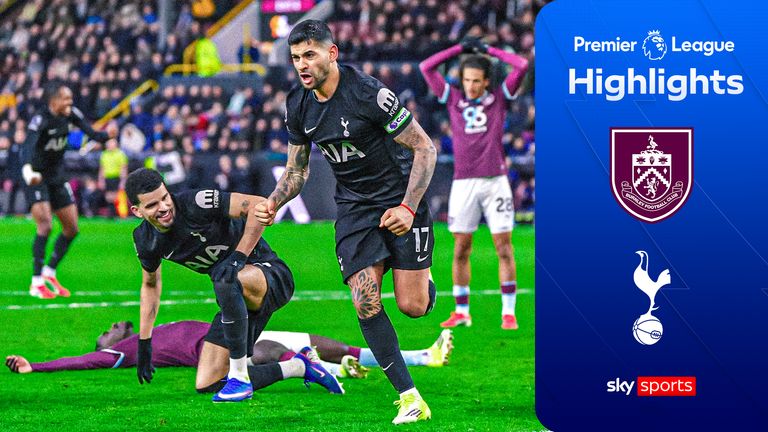
Premier League hits and misses: Are Tottenham being dragged into a relegation scrap with West Ham rejuvenated?
Tottenham just cannot win Premier League games right now.
Saturday's last-gasp 2-2 draw at Burnley extended their winless league start to 2026 to five matches.
It is also just one win from their last eight league games, in a run which has seen them lose against two of the bottom four - West Ham and Nottingham Forest.
They also needed a 90th-minute equaliser to rescue a 1-1 home draw against bottom-side Wolves in late September, which was Wolves' first point of the season.
And Spurs required another 90th-minute leveller to avoid defeat at second-bottom Burnley, who came so close to ending their 13-game winless league run.
Spurs' failure to beat the sides below them, combined with their abysmal form, has not only piled the pressure on boss Thomas Frank but raised concerns they could well get dragged into a relegation battle.
Last season, Spurs finished 17th but were never truly at risk of dropping into the bottom three as they focused on Europa League glory. But this season, the relegation scrap feels different.
Spurs started Saturday 10 points above the drop zone, but after the draw at Turf Moor and a second consecutive win for rejuvenated West Ham, Frank's side sit eight points clear of the bottom three.
Maybe what is heightening these fears is Tottenham's daunting February fixtures - the hardest any team has in the next four Premier League gameweeks.
Spurs face four top-half sides next month - Manchester City (H), Manchester United (A), Newcastle (H) and Arsenal (H). Looking at those games, it is hard to see where their next win is coming from.
And with the fans once again showing their displeasure with Frank at Turf Moor, the winter of discontent could become a whole lot worse.
Liverpool had the ball, the territory, the familiar patterns but absolutely no menace.
A 3-2 defeat to Bournemouth will sting on the scoreline, but the performance cut deeper. This was a night that laid bare a growing problem under Arne Slot of sterile control mistaken for authority.
Slot has spent much of 2026 pointing towards low blocks as the great inhibitor of Liverpool's attacking rhythm. Teams sit deep, he says. Space is denied. His players are not built for that kind of puzzle.
Except Bournemouth did not play that game.
They stepped out. They pressed. They left space in behind. And Liverpool still looked short of ideas and, most damningly, short of belief that their football could hurt anyone.
Liverpool finished with 14 shots. Those efforts amounted to just 0.83 expected goals, a figure that tells the story of their struggles. This was a team settling for the comfortable option. Shots from distance. Crosses without conviction. Attacks that slowed just as they needed acceleration.
For all the ball Liverpool had, Bournemouth always looked the more likely to land the punch that mattered. And punch they did. Bournemouth were everything Liverpool were not. Direct, decisive and daring.
Recomended Posts



© 2026 - VIPBOX - All Rights Reserved

Leave a Comment