What if a 12-year-old's sketching habit, a 19-year-old's gap year travels, and a 45-year-old's volunteer coordination all counted as verifiable learning? In a new piece for Getting Smart, Mason Pashia...
LearnKit is a proposed framework and infrastructure designed to give learners greater control over the information that describes what they know, what they can do, and how they learn. Today, learning data is fragmented across institutions, applications, credentials, employers, and other systems, making it difficult for individuals to access and use their own information. LearnKit envisions a trusted and interoperable ecosystem in which academic records, skills and competencies, goals, interests, learning experiences, and other relevant data over time can be brought together with insights.
This project explores the technical, policy, governance, and market conditions required to make that vision possible. It examines approaches to interoperability, identity, consent, privacy, and data stewardship. The paper also considers how AI agents could use learner-authorized data to provide more personalized guidance, identify opportunities, recommend learning pathways, and help individuals communicate their capabilities across education and work. Ultimately, LearnKit proposes a shift from institution-centered data systems toward learner-centered infrastructure that can support lifelong learning, mobility, and opportunity while maintaining strong safeguards for privacy, security, and trust.
All images have been provided by Gobekli.
As a part of a recent study conducted by the Gates Foundation, we contributed some visions of the future of credentialing addressing the question of “What would it look like if our investment in learner wallets paid off?” Inspired by our Blogs from the Future: 2040 series and a blog called “Why Learner Wallets Will Fail.”
Check out the fictional stories of Leo, Jamie and Elena, theree learners in different moments of their learning journey and with different needs, below.
Who is Leo?
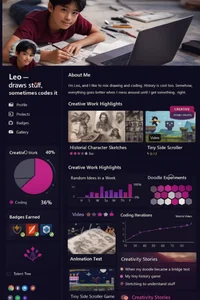
Leo is a 12-year-old from Indianapolis who likes coding, sketching, and history, but his teachers tell him he needs to “focus on one thing.” He feels guilty for jumping between hobbies and often gets told he’s lazy because he can’t stick to a schedule.
Leo would benefit from a digital record of his skills and experiences —but he’s also exactly the kind of student who would never voluntarily populate one. Not because he’s unmotivated, but because it doesn’t make sense to him. It’s hard to understand the lifelong utility of documenting a learning journey, that it’s so that he can tell the story of himself to himself, as well as to others. To empower Leo by capturing his learning journey, a tool must be immersive, motivating, and help Leo find out who he is and what he’s good at.
When Leo turned 10, he got access to his lifelong AI-powered app that interfaces directly with his state-sponsored learner record. To begin, he didn’t take a survey; he played a mini-game where he had to choose how to solve a problem.
- Result: The app assigned him his current Archetype: “The Storm Chaser.”
- The Description: “You thrive in chaos. You don’t walk a straight line; you gather energy from variety. Your superpower is Connection—connecting things that don’t belong together.”
- The Visual: His avatar is a rogue-like character with a cloak that constantly shifts colors.
Here is a week in his life.
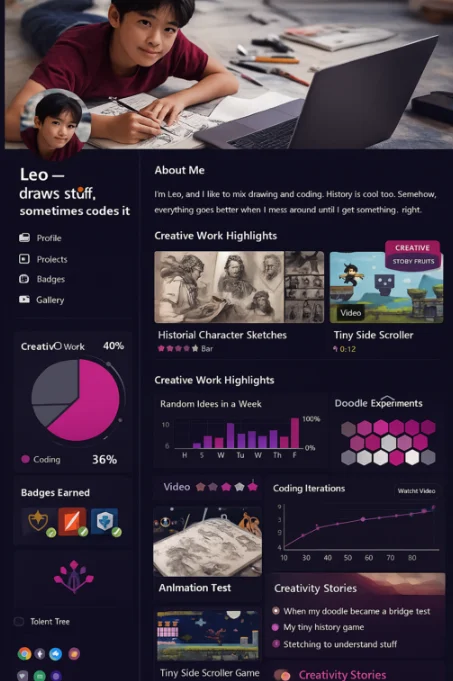
Monday: Creative Flow
Leo sketches in his notebook while he’s supposed to be working on his math skills. He feels guilty, but he’s “in the zone.” His lifelong AI passively detects creative apps being used during school hours and rewards him with “Enchanted Dust” (a creativity resource), which is stored in his personal learner record.
Then comes the critical prompt: “Your Creative Mana spiked earlier. What triggered the flow state?”
Leo chooses from multiple options:
- I was bored/avoiding work
- I had a sudden idea I couldn’t lose
- I was stressed
This matters because he’s learning to distinguish between avoidance and inspiration. That’s metacognition. That’s the kind of self-knowledge that will serve him in any future career—but it’s valuable right now for understanding himself. He selects “I had a sudden idea I couldn’t lose.”
Tuesday: Building Resilience
Leo has to get ready for a demonstration of learning he’s been dreading. He turns on “Dungeon Mode” to focus for 45 minutes. The timer sounds, and he receives a “Stone of Will.”
The prompt: “Boss Battle Complete. You defeated ‘Procrastination.’ What weapon was most effective?”
Leo tags his response: #LoFiBeats #PhoneInOtherRoom
He’s identifying environmental conditions that help him focus. Not for a college application essay, but for the next time he needs to study something difficult.
Wednesday: The Failed Test
Leo bombs his demonstration. He’s not able to get his feet under him and spends most of the time trying to focus, leaving him feeling stupid and overwhelmed. He logs a “Failed Quest,” turning his negative experience into a “Cracked Shield” (a resilience item he can use in the future).
The prompt asks: “Damage Report: You took a hit. Where was the breach in your armor?”
Leo realizes through his own reflection that the problem wasn’t “I’m dumb”—it was test anxiety. He’s not building a credential for a someday employer; he’s building self-awareness for himself, now.
Thursday: Processing Emotion
Leo is still stinging from Wednesday’s failed quest. He isolates himself. He visits the learner campfire, a virtual space where he can see other learners who recently went through a failed quest. He talks with some of them and earns “Empathy XP.” His avatar’s lantern begins to glow.
One of the avatars around the fire is a student in the class, and they decide to meet up the next day to talk about their recent experience. In the conversation he says, “I just feel like everyone else gets it faster than me. I’m tired of trying hard and still failing.” He’s practicing naming the emotion, which is the first step in regulating it. This is social-emotional learning happening organically, not as a checkbox on a rubric.
Friday: The Synthesis Moment
Leo uses geometry concepts in his art project, and it looks awesome. He posts a photo. The app recognizes the tags #Math and #Art and gives him a “Synergy Bonus.”
The prompt: “Wait… did you just use a Skill from a different class? How did Math help Art?”
Leo responds: “I used the shape patterns we learned to make the background cool.”
This is transfer of learning—the holy grail of education. And it happened because Leo actively reflected on and documented his learning journey.
While this is one example, deeper gamification and UX will ensure that learners from a range of learning modalities have ways to engage.
Signals from the Future
- Learner Employment Record Adoption (LERs): Portable, learner-owned records of growth and skills being piloted across states and platforms. Many pilots are being run across the country and states like North Dakota and Arkansas are piloting state-wide approaches to this technology.
- Unbundled & Credentialed Systems: Initiatives across the country are modeling citywide learning ecosystems with credentialed learning across sites.
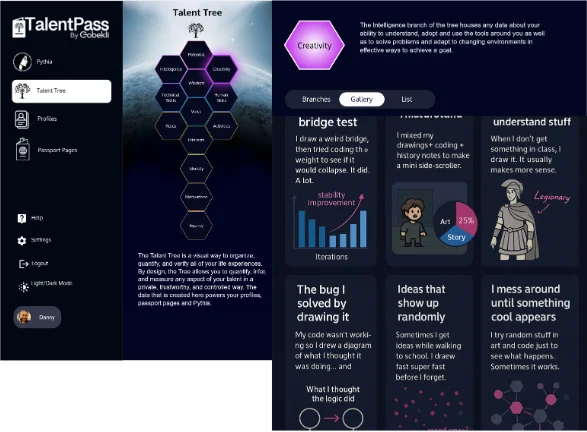
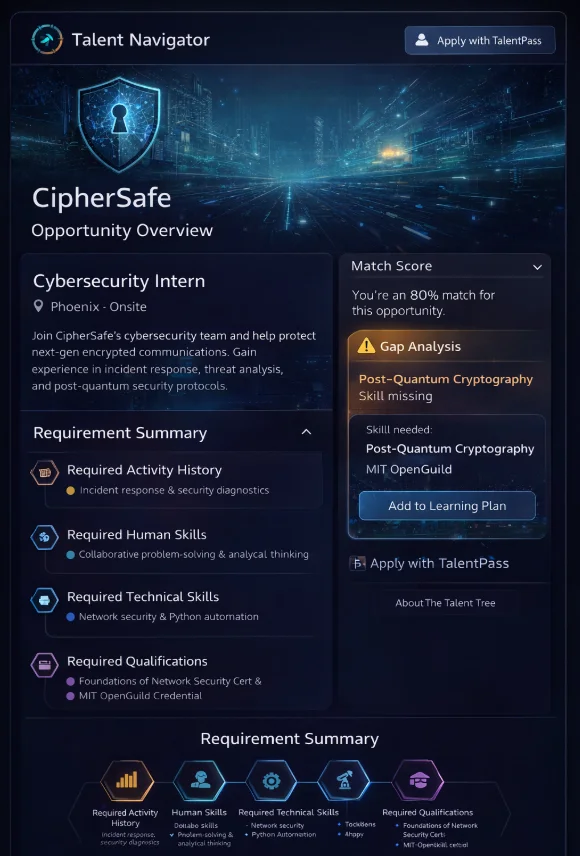
- Gobekli’s TalentPass (pictured throughout) is a Universal Talent Passport that empowers you to navigate your future, adapt, and thrive. It offers a private AI-powered profile for growth and opportunity, with full control over your data and destiny.
- LearnCard’s Lifelong Learning Passport is an open-source digital wallet that can connect to any system, designed for IDs, Skills, and Learning and Employment Records (LERs). It is a Lifelong Learning Portfolio.
- SuperBetter is a gamified experience that builds resilience – the ability to stay strong, motivated and optimistic even in the face of change and difficult challenges. Playing SuperBetter unlocks heroic potential to overcome tough situations and achieve goals that matter most.
- Pokémon Go is an augmented reality phenomenon that swept the nation, gamified into weekly and seasonal challenges that show what’s possible with thoughtful and adaptive growth challenges and structures.
- Agilities from the DeBruce Foundation are an early example of narrativizing skills into making them a core part of your identity.
Who is Jamie?
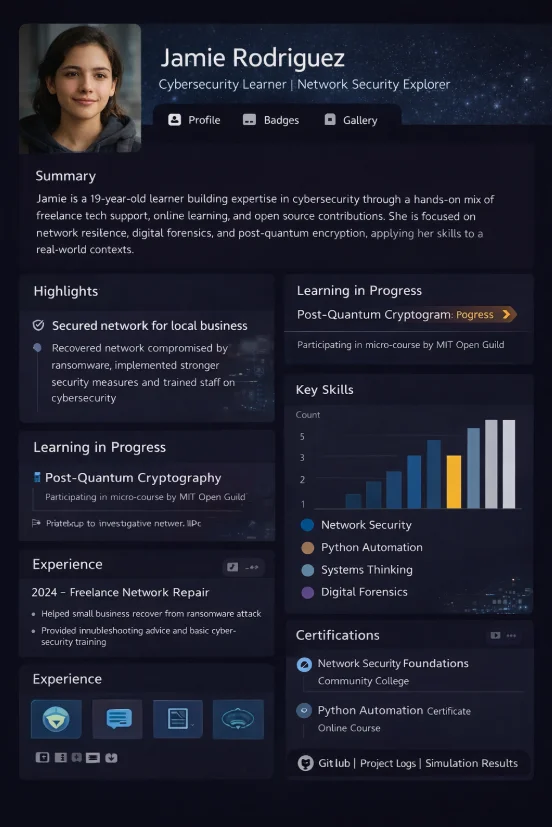
Jamie is a 19-year-old who has been studying cybersecurity and network resilience. She spent the last year travelling to see more of the world, to better understand herself, and to consider her multiple possible pathways. After a year of odd jobs and travel, it turns out her current focus on cybersecurity is still what lights her up. To get a foot in the door, she needs a high-stakes internship. Fortunately for her, this matchmaking isn’t what it used to be. Rather than scrolling through endless job boards, she activates her Talent Navigator, an AI-powered tool that integrates seamlessly with her learner record.
Unlike the old search engines, the Navigator knows Jamie’s entire Skill Architecture, which has been defined by Jamie’s inputs of experiences over the years. The Navigator doesn’t just look for keywords; it looks for culture and competency fit, looking at how she communicates, how she responds to challenges, failure, and more. Using the rich experience metadata and artifacts, her personal AI combs through global and local firms, acting as her personal scout in a crowded marketplace.
The Navigator flags a role at CipherSafe, a leading firm in secure communications. The job is local, so she wouldn’t have to move (a gift after so much travelling, and providing her with more time with her aging grandmother), and it shows a promising culture and interest match, but there’s a catch: Jamie is only an 80% match.
With technologies like resumes and transcripts, Jamie might have been filtered out automatically. In 2040, Scout—her fiduciary AI—steps in with a gap analysis and some recommendations.
- The Match: Scout identifies that CipherSafe is transitioning to “post-quantum cryptography.”
- The Nudge: “Jamie,” Scout whispers through her haptics, “you have the foundational math, but you’re missing this specific credential. I’ve found a four-week micro-course from the MIT-Open-Guild that will close this gap.”
- The Action: Jamie doesn’t just apply and pray. She adopts the learning plan. Her public-facing record gets marked with “In-Progress: Mastery Pending,” showing the employer she isn’t just a candidate, but a self-directed learner who anticipates market shifts.
The Application: Selective Disclosure
When Jamie hits “Apply,” no PDF is generated. Instead, she is taken to her digital record, where she has complete authorship over her story. She doesn’t want (or need) CipherSafe to see everything—her project-based experiences from early middle school or her private journals aren’t relevant—but she does want to share her verified “Systems Thinking” badges, some of the projects from high school where she helped a small local business implement a cyber security layer, and even some of her personal learning reflections where she talked about overcoming adversity in collaborative environments. She even adds the travelogue from her last year, letting them see what Jamie saw and get a better understanding of who she is as a person as well as a candidate. Lastly, she sets the secure link to expire in 30 days, ensuring she remains the owner of her own story.
The Simulation: Living Proof
Once the link is registered for the application, Jamie is redirected to a simulation portal.
“Are you ready for this 30-minute simulation? There will be two questions.”
Jamie is ready and proceeds. An avatar pops up on the screen asking Jamie how she’s doing, and there are about 5 minutes of small talk before the first question is asked. Jamie feels comfortable with her answer and can even reference her high school project to demonstrate how to set up early cyber infrastructure.
The second question is a bit harder. It’s about crisis response, which Jamie hasn’t had to handle much yet. That said, she reasons well and describes her thought process. The avatar thanks her for her time, and after the interview, Jamie sees an immediate readout of her performance. At the end, it tells her that the application window closes in a week, but that she did a great job — they’ll let her know as soon as the last candidate is interviewed.
Like clockwork, she gets a notification a week later that she has advanced to the interview round. They want to talk face-to-face.
The Interview: Verifiable Evidence
“Tell us about a time you handled extreme pressure,” the interviewer kicks off.
She knows they have the data from her simulation last week, and in the old days this is where a candidate would shoot from the hip, telling a story and struggling with the right level of specificity—now she provides proof. She turns this small exchange into a personal TED Talk, using verifiable artifacts from her learner record: an anonymized communication thread from a past project where a server went down at 2:00 AM, and she had to respond. The recruiter doesn’t have to take her word for it; they see the time-stamped decision-making, the calm communication, and the successful resolution, as well as supervisor validation, all stored within the experience.
From there, she pulls up some images from her recent travels, this one being a few days in Barcelona, where, for some reason, she wasn’t able to get into her hostel and describes how she solved the problem. Life data matters—no matter where it happens.
The Negotiation: Value Capture
The offer comes in quickly, and Jamie doesn’t have to guess her worth. She uses the Navigator to view real-time, verified compensation data for her specific skill stack in her region.
Because her learner record includes a Verified Patent Filing for a small security patch she wrote last year, she has leverage. She doesn’t just accept the entry-level rate; she justifies a 15% increase based on the calculated value of her existing contributions.
The Outcome
For Jamie, the internship is a great fit. Because of the digital record, her team already knows her strengths, her learning style, and her capacity for growth. Jamie’s career isn’t something she started after she graduated—it’s something she has been building, one verified moment at a time, since she was first equipped with her digital record as a 10-year-old.
Signals from the Future
This possible future was based on the following signals from communities and projects around the world.
- A Solutionary Workforce. The Knowledge Society is a program that equips students with rapid exposure to mindsets, emerging technologies and global challenges. The students then put these elements together to create a solution to a purpose-driven problem.
- Counting all Experience. LivedX, a platform that enables students to input their experiences into a tool that uses AI to process the demonstrated durable skills and stacks them into skills certificates that are exchangeable for college credit.
- SchoolJoy. SchoolJoy’s Nimo is an AI-powered Simulation tool that through voice conversations can assess someone’s performance, offer feedback and make a competency-based assessment against a predefined rubric.
Who is Elena?
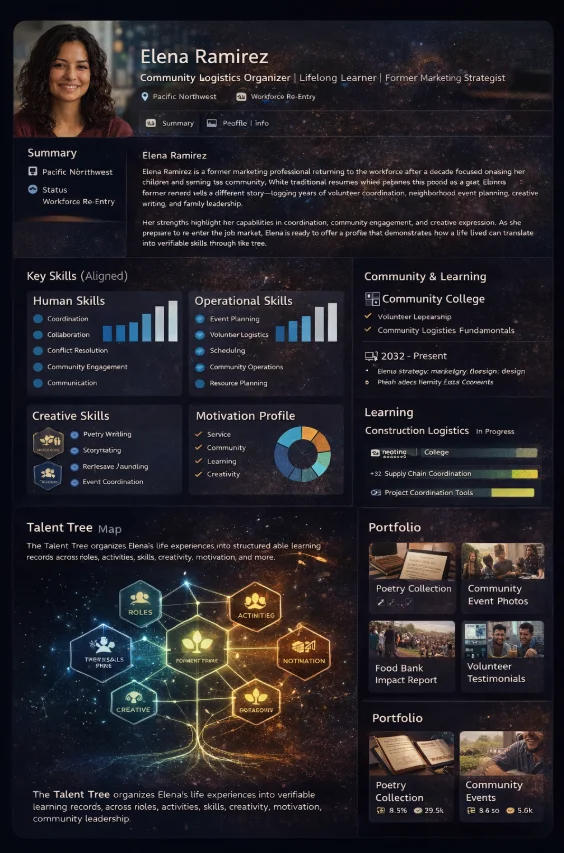
Elena is a 45-year-old mother returning to work after her two kids reached a more independent age. She’s told that she has been out of the workforce at a “bad time” as she has missed several “critical technological advances.” Her last resume is a monument to roles that no longer exist, despite having fifteen years as a marketing professional. Fortunately for her, learner records rolled out a decade prior, and a life lived is a lot learned. For the past decade, Elena has used her personal AI Scout to keep building her personal record — sharing her challenges and growth as a mother, her poetry, and her community volunteer work. She helps manage the volunteers at the local food bank (when she’s not volunteering herself) and regularly coordinates parties for the neighborhood.
All of these experiences have been accruing with rich documentation of where she was, multimedia accounts of her reflections and growth, and a handful of skills learned along the way… the shift from a phone to a holographic watch had a bit of a learning curve, but she was fully with it now.
Diving Back In
To get started, Elena visits her personal dashboard and sees that lately she’s been building and validating skills like Coordination, Collaboration and Management. Using these as cornerstones, she asks her AI to look for roles at local companies where her skills make her a strong candidate.
Scout reassures her that she’d be a great fit for many roles and shows her her skill overlap with available roles in the area, providing proof to the fact that she isn’t starting from zero. Her wide range of lived experience aggregates into valuable, transferable skills and made her a 70% match for a job opening at a local construction company: Director of Logistics and Coordination.
“Interested? Let’s start filling that gap.” Scout says.
The Bridge: Unbundled Lifelong Learning
In 2040, companies view education as a retention strategy, not an overhead cost. Elena looks around and finds a few online credentials and some classes at her local community college for upskilling in construction, logistics and some of the latest tools. Using a lifelong learning fund sponsored by the state, she enrolls in a few of these courses. She doesn’t need a full four-year degree to communicate capability; instead, she gets verifiable credit for every completed lesson, project and skill. She chooses courses that fit her schedule (either async or while the kids are doing projects of their own), and the moment she demonstrates mastery, the verified credential is issued directly to her record, creating no latency between capability and potential.
As she worked through getting this credential, her progress was logged in her digital record. When it came time to apply, she made a public version of her skill profile, which included both personal and professional experiences, and shared it with the prospective employer. A part of this profile was a video walkthrough with testimonials from one of the recent community gatherings she had planned, as well as the impact report for the local food bank that she helped flow smoothly.
Well-rounded Flourishing
As she’s about to leave her dashboard, Scout says, “Hey, that latest poem you wrote … I love it. It looks like Poetry Daily has open submissions right now. Do we want to work on submitting?”
The LER wasn’t just a way to navigate a messy workforce landscape but a way to continue to pursue personal goals as well, all while providing Elena with a higher resolution portrait of … Elena.
She says that she wants to submit, but not right now, and Scout says, “Ok, I put a reminder on your calendar to get started. There’s also an open reading down the street at L&R Cafe tonight, which is just a three-minute walk from your kids’ Gymboree class.”
“Ha, we’ll see about that,” Elena says.
Scout does an applause of snaps as if to simulate a poetry reading and then says, “By the way, you’ve been working really hard lately and are due for some restoration.” This is the most radical shift in Elena’s interoperable world—the Wellness & Balance Quadrant. In the 2020s, a “gap” on a resume was a red flag. In 2040, the system recognizes that balance is a competency and integrates fully with health apps and wearable technologies to provide a holistic image.
Scout noticed that Elena’s wellness graph dipped into the “Recovery” zone after her recent high-intensity upskilling. In moments like this, Scout doesn’t suggest a new course; instead, it encourages her to spend time with friends and family and do activities that historically have earned Elena restoration points. First, Scout greyed out her productivity dashboard for four hours, logging it as “Intentional Rest”. From there, it recommended activities like yoga and meditation instead of online courses and job hunting. Every time Elena participates in one of these health classes, her personal battery recharges, and her wellness score rises.
Collaborative Experiences
During her restoration block, Elena decides to try a new recipe with her kids. They love injera bread but find the store-bought version to be a bit like styrofoam. Together, they find a recipe and make it to go along with their wat and curries. Her kids record some of the cooking process and at the end, they take a picture with a basket overflowing with spongy injera. They submit this experience and tag each other in it, adding the cooking experience to all of their records. Throughout the process, the kids asked numerous questions about Ethiopian culture, why this kind of bread, etc., and they’re rewarded with curiosity points as well as a “Tried a New Thing” badge.
Not only did they get a delicious meal and a home video out of the experience, but they got to recognize it as learning that counts. Sounds of friends in the other room indicate that they are hungry, and one by one the plates are taken into the dining room.
Signals from the Future
This possible future was based on the following signals from communities and projects around the world.
- Apple’s Health App is an intuitive tool that gathers data from all kinds of sources: verified, self-attested, actively tracked (Strava, AllTrails, etc.) and passively tracked (pedometer, Apple Watch, etc.). It is, first and foremost, of use to the user.
- The WGU Achievement Wallet from Western Governors University is a platform for skills identification, occupational alignment, career exploration, and credential management. Their platform has been primarily tested and informed by current WGU students, employers through the Aspen Institute, and non-completer surveys. This tool consists of four functional sections: a profile section showing skills gaps, a credential section for managing credentials, a skills section with detailed information for resume writing, and a career pathways section for job alignment discovery.
- Learning for All Ages: Across the world, countries are recognizing the importance of upskilling and reskilling, meaning that experiences never stop.
- Singapore recently introduced a monthly allowance to help mid-career professionals train in meaningful new skills.
- France offers the Compte Personnel de Formation, an account of training credits available to all workers, including freelancers, for use on a wide range of certified reskilling programs.
- Sweden’s Transition Study Support (Omställningsstudiestöd) covers up to 80% of salary for up to 44 weeks for workers looking to change fields.
- South Korea has operated a Lifelong Education Promotion Plan since 2002, which includes the National Tomorrow Learning Card—a voucher system that helps fund vocational training for both employed and unemployed individuals.
The post What Will It Look Like If Investment in Learner Wallets Pays Off? appeared first on Getting Smart.
Discussion
Sign in to join the discussion.