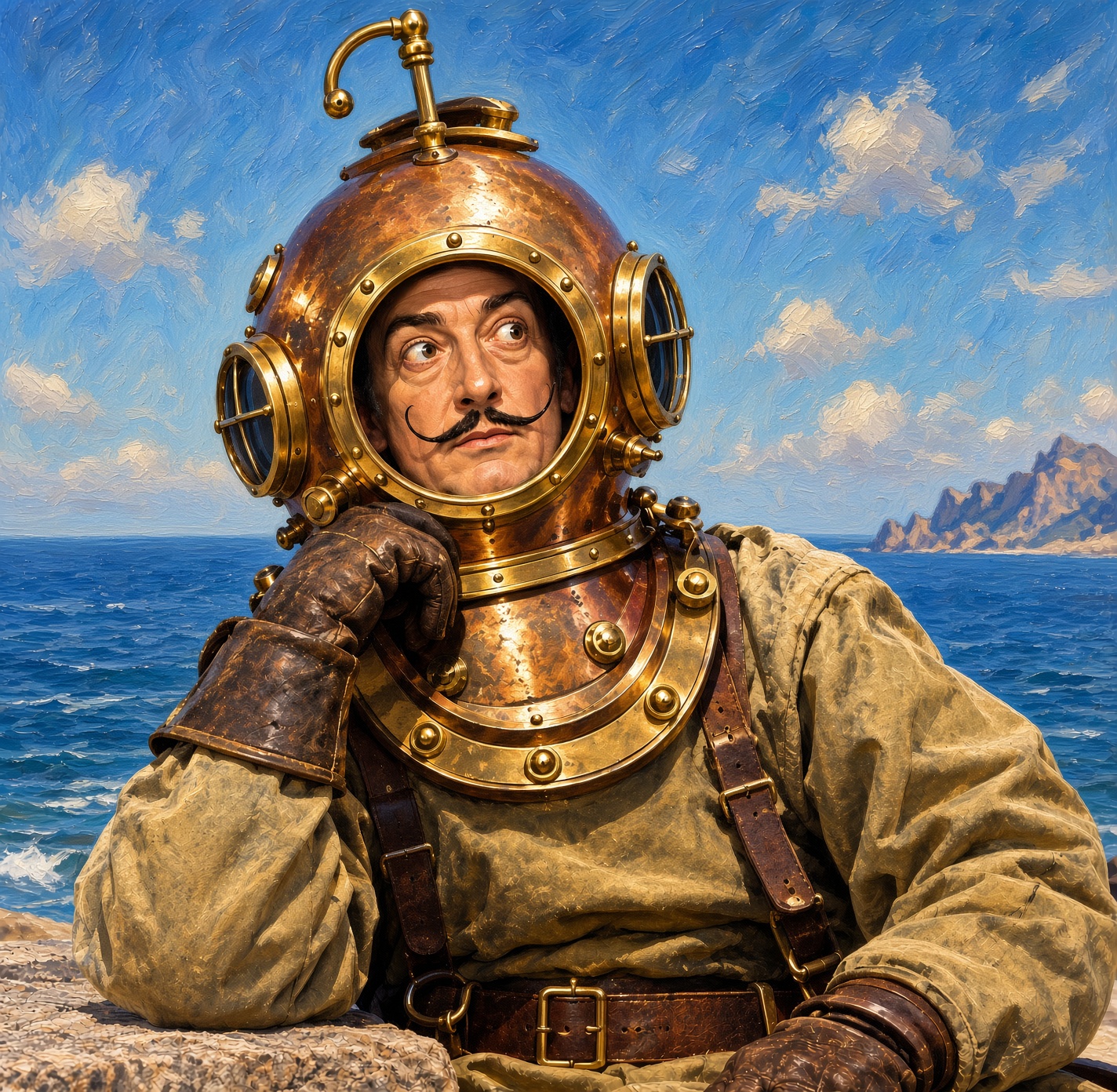
Salvador Dalí's 1936 lecture in a diving suit became a memorable blend of humor and chaos when he almost succumbed to suffocation on stage.
Dalí's Daring Entrance
In the summer of 1936, London hosted the International Surrealist Exhibition, which despite initial backlash from the press, became a notable success. Drawing luminaries such as Pablo Picasso and René Magritte, the exhibition famously highlighted Salvador Dalí, who made a memorable entrance to deliver a lecture titled “Authentic Paranoiac Phantoms.” To embody the surreal experience he aimed to communicate, he donned an elaborate diving suit complete with a heavy helmet that bordered on theatrical absurdity.
This eccentric choice wasn’t merely for effect—Dalí sought to immerse his audience in a true surreal experience, aiming to make them question the boundaries of reality. His willingness to embrace discomfort pointed to a larger ethos in the Surrealist movement. In an art scene often steeped in conventionality, Dalí's decision to wear a diving suit also served as commentary on the depths of the subconscious mind, emphasizing the lengths one must go to explore the untapped corners of creativity. The diving suit became a vessel not just for his physical body, but for the ideas swirling in the unseen depths of human psyche.
A Struggle for Breath
As Dalí took the stage, he soon discovered that his bold interpretation of Surrealism came with unintended consequences. The diving suit, complete with cumbersome lead shoes, severely hampered his mobility. In his autobiography, he described the struggle to walk, needing assistance as he appeared on stage with two stylish white Russian wolfhounds in tow. In this moment, he became not just an artist but also a performer entangled in a form of existential struggle, resembling the very themes of alienation and chaos prevalent in Surrealism. As he fought to maintain composure, he realized that speaking through the helmet’s glass was all but impossible.
After ten minutes confined in what was meant to be a surreal costume, he began to feel the effects of heat and discomfort. With the audience unaware of his distress, they likely assumed it was all part of the act when Dalí turned pale from the effort. Gala, his wife, and friend Edward James faced a frantic race against time to release him. They resorted to hammering the bolts to free him, Dalí recounting that each blow pushed him closer to fainting. The tension of this moment brought the absurdity of his costume full circle; here was a man literally trapped within a construct designed to liberate. This contrast served as a metaphor for the often contradictory nature of artistic freedom and personal struggle, leaving audiences pondering just how far one must go to pursue art.
Surreal Performance
When Dalí finally emerged from his predicament, his dramatic pallor was interpreted as a striking aspect of his surrealistic performance. Unfazed by the earlier chaos, he proceeded to the visual component of his lecture, presenting slides in disarray and mostly upside down. This approach perfectly embodied the unpredictable nature of the Surrealist movement. Dalí’s intent was clear: to break all conventions of how a lecture should be delivered. He turned the act of presentation into an artwork itself, enticing the audience to question perception and reality while experiencing a disorienting mixture of both.
The audience's response added another layer to the performance. Were they witnessing genuine confusion or a calculated act of absurd elegance? Every misaligned slide and unhinged word became part of a grander narrative that both invited and repelled traditional expectations of academic discourse. This blurred line between absurdity and profundity is what keeps the essence of Surrealism alive even today, challenging how we engage with art and meaning.
The Exhibition’s Impact
The International Surrealist Exhibition attracted roughly 30,000 visitors during its brief three-week tenure. Reflection on its success often piques curiosity about how much further the movement could have progressed, especially without the looming threat of war darkening Europe’s horizon. Critics of the era were skeptical of Surrealism's fit within British culture, yet the essence of surreal humor resonated deeply within a nation known for its own blend of eccentricity. This paradox reveals a rich cultural dialogue—while the British may have seemed resistant to Surrealism, aspects of it mirrored their own national identity.
Critic Herbert Read commented in the exhibition's catalog that England, having birthed creative minds like William Blake and Lewis Carroll, was inherently suited to the bizarre and nonsensical. This cultural tension between traditional decorum and avant-garde art made the exhibition an exhilarating yet contentious affair. The exhibition not only fostered dialogue amongst artists and theorists but also connected with the broader public, challenging their preconceptions of art and its role in society. What’s fascinating here is how the event drew people into an aesthetic philosophy that, while foreign to many, somehow mirrored their own lived experiences.
Implications and Future Outlook
The International Surrealist Exhibition marked a shift in the art world, embedding the notion that art could—and should—defy conventional expectations. The reckless freedom embodied by Dalí and his peers opened the door for future movements to explore themes of irrationality, dreams, and the absurd. If you're working in this space—be it fine arts, performance, or even digital media—this historical moment carries value. Artists looking to evoke emotional reactions might find inspiration in Dalí's fearless approach and willingness to blend theatricality with philosophy.
This moment in art history also raises questions about the authority of the artist and the role of the audience. Are we still tied to the classical methods of engaging with art? How far can creators push boundaries before the audience disengages? The blend of chaos and profundity that Dalí showcased will continue to resonate, bearing implications that extend beyond the gallery walls into contemporary culture. The outcome of this confluence could determine the trajectory of how we perceive, interact with, and value art across varied contexts.
Related Content:
The Surrealists' Dismissal of Salvador Dalí for Embracing Fascism (1934)
Dalí's Meeting with Sigmund Freud: A Mind-Altering Encounter (1938)
Creating a Surrealist Funhouse at the 1939 New York World's Fair
Dalí's Dramatic Demolition of a NYC Department Store Window (1939)
Dalí’s Surreal Lecture at the Sorbonne in a Cauliflower-Filled Rolls Royce (1955)
Dalí's Surreal Encounter with Mike Wallace (1958)
Based in Seoul, Colin M a rshall writes and broadcasts on cities, language, and culture. He’s the author of the newsletter Books on Cities as well as the books 한국 요약 금지 (No Summarizing Korea) and Korean Newtro. Follow him on the social network formerly known as Twitter at @colinma rshall.
Discussion
Sign in to join the discussion.